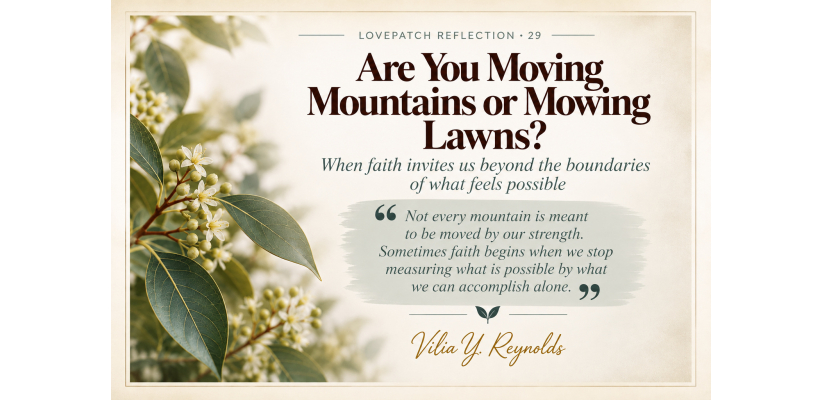
When faith invites us beyond the boundaries of what feels possible
By Vilia Y. Reynolds
Sometimes we become so occupied with maintaining what is familiar that we stop considering what might still be possible.
We attend to our responsibilities. We manage our routines. We solve everyday problems. We keep things organised. And we do our best to maintain the life we have built.
There is nothing wrong with this.
Ordinary responsibilities matter. Faithfulness in small things can be a meaningful expression of love, commitment and personal responsibility.
But sometimes, beneath the familiarity of everyday life, there is a quiet longing.
A desire to grow. A dream we have postponed. A change we have been afraid to make. A calling we have questioned because it appears beyond our abilities.
And perhaps we begin wondering whether we have become so comfortable maintaining what already exists that we have stopped recognising what God may be inviting us to explore.
Are we simply maintaining what is familiar, or are we still willing to trust God with what seems impossible?
When Maintaining Becomes Our Comfort Zone
I often think about the difference between a lawnmower and a mountain-mover.
A lawnmower maintains what has already been established. It follows familiar boundaries. It keeps things neat. It performs a necessary task, often repeatedly.
A mountain-mover, however, represents something different. It suggests courage in the face of an obstacle that appears immovable. It invites us to consider possibilities beyond the limitations we have come to accept.
Of course, neither image should be understood literally.
Maintaining a home, caring for a family, fulfilling responsibilities or living a quiet life of service is not inferior to pursuing extraordinary achievements.
Sometimes the most meaningful expressions of faith occur in places nobody else notices.
But there can be moments when maintaining what is familiar becomes a way of avoiding what feels uncertain.
We remain within established boundaries because we know what to expect. We repeat familiar routines because they feel manageable. And we postpone difficult decisions because we are uncertain whether we have the courage to respond differently.
Perhaps the question is not whether we are doing enough. Perhaps it is whether fear has quietly begun determining what we believe is possible.
When the Mountain Is Within Us
Not every mountain stands in front of us.
Sometimes the greatest obstacles are the beliefs we have developed about ourselves.
I am not capable. I am too old. I have missed my opportunity. I have failed before. I do not have what it takes. Someone else would do it better.
These beliefs may have developed through earlier experiences of rejection, disappointment, criticism or failure.
Sometimes they reflect genuine limitations that deserve thoughtful consideration. But sometimes they become conclusions we continue carrying long after our circumstances have changed.
We may have learned to protect ourselves from disappointment by expecting less. To avoid rejection by never attempting something unfamiliar. Or to prevent failure by remaining within the boundaries of what we already know.
What feels like wisdom may sometimes be fear speaking through an old belief.
And perhaps personal growth begins when we become curious about the difference.
Is this genuinely beyond my abilities? Or have I stopped considering what might be possible? Am I making a thoughtful decision? Or am I allowing an earlier disappointment to determine my future?
These questions do not require us to ignore our limitations. They invite us to recognise when those limitations are real and when they may deserve reconsideration.
When Faith Meets the Impossible
In Matthew 17:20, Jesus uses the extraordinary image of faith moving a mountain.
His words arise within a conversation about faith and the disciples’ inability to accomplish something they had attempted.
The mountain becomes a powerful illustration of what appears impossible from a human perspective.
Yet the passage should not be understood as a promise that every difficulty will disappear if we believe strongly enough.
Nor does it mean that an unresolved struggle necessarily reveals insufficient faith.
Christian faith is not a technique for controlling circumstances. It is an invitation to trust God.
And perhaps this distinction changes the way we approach the mountains before us.
We do not have to pretend that something is easy when it is difficult. We do not have to deny uncertainty. We do not have to assume that courage means having no fear.
Instead, we can bring our limitations honestly before God. We can seek wisdom. Consider our responsibilities. Receive appropriate guidance. And remain open to taking the next faithful step.
Sometimes the mountain may move. Sometimes we may discover another way around it. And sometimes what changes first is our understanding of what the journey requires.
When Courage Begins With a Small Step
Perhaps one of the difficulties with the image of moving mountains is that we begin imagining dramatic breakthroughs.
We expect something extraordinary. A sudden opportunity. A life-changing event. A moment when everything becomes clear.
But meaningful change often unfolds more gradually.
Through a conversation we have been avoiding. A decision we have postponed. A boundary we finally establish. A new skill we begin developing. A request for help. Or the willingness to try again after disappointment.
These actions may appear small. Yet they can represent meaningful courage.
For someone recovering from overwhelming experiences, even considering a different future may require considerable emotional effort.
Growth should never become another demand placed upon someone who is already struggling.
Sometimes courage involves pursuing a new opportunity. Sometimes it involves resting. Sometimes it means recognising that we cannot carry everything alone.
And sometimes it means accepting that the path forward may look different from the one we originally imagined.
Faith does not require us to become extraordinary performers. It invites us to respond faithfully to the opportunities and responsibilities before us.
When Our Calling Is Greater Than Our Fear
Within Christian living, purpose is not measured simply by visible achievement.
A person’s calling may involve teaching, leading, creating, encouraging or serving. It may involve raising children. Caring for someone who is vulnerable. Supporting a person through grief. Or quietly remaining faithful through a difficult season.
These contributions may never attract public recognition. Yet they can carry profound meaning.
The invitation is not to compare the size of our calling with someone else’s. It is to consider whether we are living in ways that reflect our values, responsibilities and relationship with God.
Sometimes we may need to challenge beliefs that have limited us. Sometimes we may need to reconsider a familiar pattern. And sometimes we may discover that the courage we have been searching for begins with trusting God enough to take one small step.
Not every mountain is meant to be moved by our strength. Sometimes faith begins when we stop measuring what is possible by what we can accomplish alone.
Perhaps the question is not whether we have achieved something remarkable. Perhaps it is whether we remain willing to grow. To listen. To respond. To trust.
And to recognise that our present circumstances do not necessarily define every possibility that lies ahead.
We do not need to despise the ordinary responsibilities of life. Nor do we need to pursue extraordinary achievements simply to prove our worth.
But perhaps we can remain attentive to the moments when God invites us beyond a fear we have mistaken for a permanent boundary.
Because mountain-moving faith is not ultimately about the size of the mountain.
It is about the One in whom we place our trust.
And sometimes the first movement is not in the mountain before us. It is in the courage to believe that another step may still be possible.
A Moment to Explore
When you consider the challenges or opportunities before you, where might a familiar fear or limiting belief be holding you back from taking a thoughtful, faithful step towards something meaningful?
LovePatch Reflections | CRCTC
Embracing Change. Choosing Your Way Forward.
Vilia Y. Reynolds