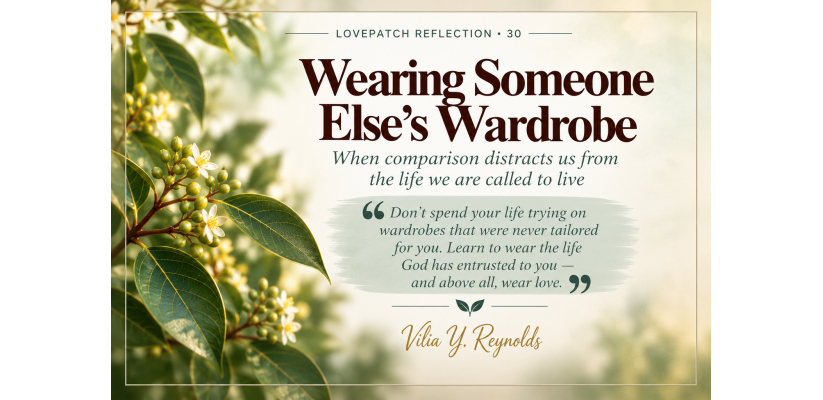
When comparison distracts us from the life we are called to live
By Vilia Y. Reynolds
Sometimes we become so interested in another person's life that we begin losing sight of our own.
We scroll through social media.
Someone announces a promotion.
Someone buys a beautiful home.
Another shares photographs of a wonderful family holiday.
Someone celebrates an achievement we have been hoping for ourselves.
And suddenly, something within us begins changing.
What initially appeared interesting or encouraging becomes a quiet comparison.
Why haven't I achieved that?
What am I doing wrong?
Why does everything seem easier for them?
Perhaps I am not doing enough.
Without even recognising it, we begin measuring our lives against someone else's circumstances.
But comparison has another side that we seldom discuss.
Sometimes we encounter someone who once disappointed, rejected or hurt us.
We hear that their business has failed.
Their relationship has become difficult.
Or something they once seemed so confident about has fallen apart.
And somewhere within us, a quiet thought appears.
Perhaps they deserved it.
One comparison leaves us feeling inadequate.
The other may leave us feeling momentarily superior or vindicated.
Yet both have something in common.
We have allowed another person's life to become the measure through which we experience our own.
When Admiration Becomes Comparison
There is nothing inherently wrong with admiring another person's achievements.
We can learn from their experiences.
Celebrate their progress.
Appreciate their abilities.
And feel encouraged by what they have accomplished.
Sometimes another person's success helps us recognise possibilities we had not previously considered.
But there is a difference between inspiration and comparison.
Inspiration invites us to grow.
Comparison may begin questioning our worth.
Instead of recognising another person's achievement as part of their story, we begin treating it as evidence that something is missing from ours.
Their promotion becomes our supposed failure.
Their happiness becomes our inadequacy.
Their possessions become the standard against which we measure our own lives.
And slowly, gratitude may give way to dissatisfaction.
We stop noticing what is meaningful within our circumstances because our attention has become fixed on what someone else appears to have.
Yet we seldom know the complete story behind another person's life.
We see the photograph.
The achievement.
The celebration.
But not necessarily the sacrifices, uncertainties, disappointments or responsibilities that accompany it.
And perhaps we are comparing the complexity of our own experience with only a small, carefully selected part of theirs.
When Someone Else's Misfortune Feels Like Justice
Comparison does not always begin with admiration.
Sometimes it begins with pain.
Someone has treated us unfairly.
We have felt rejected, humiliated or betrayed.
Perhaps we watched them prosper while we continued carrying the consequences of what happened.
And when something difficult eventually happens in their lives, we may experience an unexpected sense of satisfaction.
Now they know what suffering feels like.
Perhaps life has finally caught up with them.
Maybe justice has been served.
These responses can be uncomfortable to acknowledge.
Yet becoming aware of them does not require us to condemn ourselves.
Sometimes resentment develops when an experience of injustice remains painful or unresolved.
We may long for acknowledgement.
For accountability.
For an apology that never came.
Or simply for some indication that what happened to us mattered.
But another person's suffering does not necessarily bring the understanding, accountability or healing we need.
Their difficulty cannot change what happened.
And their failure does not establish our worth.
Perhaps the invitation is to recognise the pain beneath the comparison rather than allowing resentment to become another place in which we remain emotionally occupied.
When Someone Else Occupies Our Inner Space
One of the thoughts I return to is this:
They are occupying space in our minds that belongs to us.
Every time we revisit another person's achievements to measure our inadequacy, we give their circumstances influence over how we experience ourselves.
Every time we dwell on someone else's misfortune to reassure ourselves that justice has occurred, we may remain emotionally connected to an experience we long to move beyond.
And sometimes, without noticing, we begin living in response to another person's story.
Their success determines our satisfaction.
Their failure determines our relief.
Their opinion influences our confidence.
Their approval becomes something we pursue.
But our lives deserve more than becoming continuous reactions to the circumstances of others.
We have our own responsibilities.
Our own relationships.
Our own values.
Our own opportunities for growth.
And our own choices about how we wish to live.
Perhaps emotional freedom begins when we recognise where our attention has been resting and gently invite it back to what genuinely belongs to us.
When We Try on Someone Else's Wardrobe
Within my Wardrobe of Love™ understanding, I often think about the attitudes and expectations we wear throughout life.
Some fit the person we are becoming.
Others may have developed through disappointment, insecurity, rejection or the desire to be accepted.
Comparison can become one of those familiar garments.
We try on another person's achievements, believing they might make us feel more significant.
We measure ourselves against their opportunities.
Their appearance.
Their abilities.
Their relationships.
And sometimes we even measure our worth against their failures.
But no matter how attractive another person's wardrobe appears, it was never designed to represent the whole of our own life.
Their circumstances are not ours.
Their gifts are not ours.
Their responsibilities are not ours.
And their journey does not determine our value.
This does not mean we cannot learn from others or aspire towards meaningful achievements.
It means we can do so without losing ourselves in the process.
Perhaps the question is not:
Why am I not living their life?
Perhaps it is:
Am I living my own life with intention, gratitude and love?
When Love Changes the Way We See Others
In Colossians 3:12–14, Paul encourages believers to put on compassion, kindness, humility, gentleness, patience, forgiveness and, above all, love.
These qualities offer a meaningful way of considering how we respond to other people's circumstances.
Compassion reminds us that another person's life may contain difficulties we cannot see.
Humility helps us recognise that our worth does not depend on being more successful than someone else.
Kindness creates room to celebrate another person's achievements without feeling diminished.
Forgiveness may help us begin releasing resentment, while still recognising that forgiveness does not remove responsibility or require reconciliation with someone who remains unsafe.
And love invites us to approach others without continually turning their circumstances into measurements of our own significance.
Comparison asks:
Why them?
Love may invite us to ask:
How can I appreciate what is good in their lives?
Comparison asks:
Why not me?
Gratitude may invite us to consider:
What is meaningful and valuable in the life I have been entrusted with?
These questions do not remove every feeling of envy, disappointment or resentment.
But they may help us respond with greater awareness rather than allowing those feelings to determine our choices.
When We Return to Our Own Wardrobe
Perhaps one of the gentlest changes we can make is learning to recognise when we have begun wearing expectations that do not belong to us.
We do not have to pursue another person's career to have purpose.
We do not have to possess what someone else owns to experience contentment.
We do not have to prove that we are more successful to recognise our worth.
And we do not need another person's failure to establish that our own suffering mattered.
Within Christian living, we can approach our circumstances with the understanding that our identity is not determined by comparison.
We are invited to live responsibly, develop our gifts, care for others and pursue what is meaningful within the opportunities and limitations of our own lives.
Sometimes this involves growth.
Sometimes contentment.
Sometimes accepting what we cannot change.
And sometimes recognising that our attention has been directed towards someone else's life for far too long.
“Don't spend your life trying on wardrobes that were never tailored for you. Learn to wear the life God has entrusted to you — and above all, wear love.”
Perhaps the next time comparison begins whispering, we can pause.
Notice what we are feeling.
Become curious about what has stirred those emotions.
And gently return our attention to our own lives.
Not because other people no longer matter.
But because their lives were never intended to become the measure of ours.
Their achievements can inspire us.
Their difficulties can awaken compassion.
And their stories can remind us that every human life contains experiences we may never fully understand.
But we do not have to wear their wardrobe.
We can return to our own.
And above all, we can choose to wear love.
A Moment to Explore
When you notice yourself comparing your life with another person's success or failure, what might help you redirect your attention towards your own values, responsibilities and the life you are called to live?
LovePatch Reflections | CRCTC
Embracing Change. Choosing Your Way Forward.
Vilia Y. Reynolds