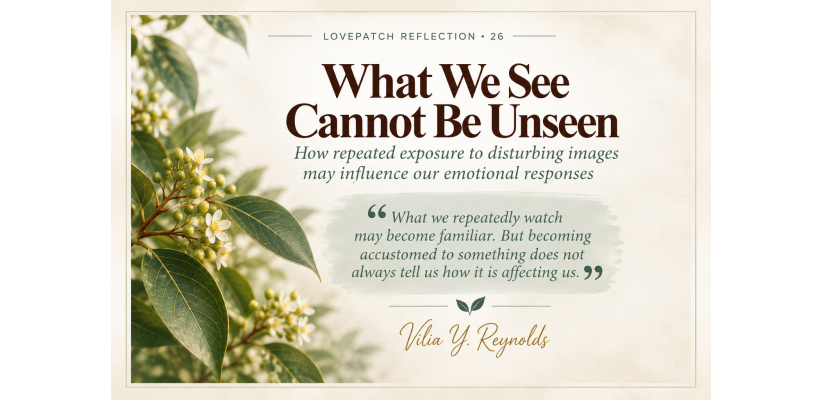
How repeated exposure to disturbing images may influence our emotional responses
By Vilia Y. Reynolds
There is a quiet moment that most people seldom think about.
The screen goes dark.
The credits begin to roll.
The room becomes still.
The film is over.
And perhaps we simply switch off the television, put down our phones and continue with our lives.
Sometimes we feel entertained. Sometimes deeply moved. Sometimes frightened, disturbed or unsettled. And sometimes we feel almost nothing at all.
We may even say:
It doesn’t affect me. I’ve watched these kinds of films for years. It’s only a movie.
And perhaps, for that person, the experience genuinely has little lasting effect.
But what if there is another question worth considering?
Does becoming accustomed to something necessarily tell us everything about how we experience it?
When Familiarity Changes Our Responses
Human beings have a remarkable capacity to adapt.
Something that initially feels unfamiliar, intense or unsettling may become easier to tolerate after repeated exposure.
We see this in many aspects of everyday life.
A sound that once distracted us becomes part of the background. An unfamiliar environment gradually feels comfortable. An activity that initially required considerable concentration becomes easier through practice.
And sometimes, images or scenes that once provoked strong emotions become less disturbing.
In psychology, this reduction in response following repeated exposure is often described as habituation.
With certain forms of media, people may also experience changes in their emotional sensitivity to repeated depictions of violence or distress.
But becoming familiar with something does not automatically mean that it is harmful.
Nor does a reduced emotional response necessarily indicate that someone has become emotionally numb.
Our reactions depend on many factors.
The content. Our personal experiences. Our expectations. Our age and development. The circumstances in which we are watching. And the meaning we attach to what we see.
Sometimes familiarity simply reflects learning. At other times, it may invite us to become more curious about how we are responding.
When the Nervous System Responds to What We See
Our responses to media are not limited to conscious thoughts.
A suspenseful scene may make our hearts beat faster. An unexpected sound may startle us. A frightening image may leave us feeling tense. A moving story may bring tears.
These responses involve complex interactions between attention, emotion, memory, interpretation and the body’s stress-response systems.
Even when we understand that a film is fictional, we can still become emotionally or physically engaged with what is happening on the screen.
Our brains are capable of recognising the difference between imagined and actual events, while also responding to stories, images and sounds that carry emotional meaning.
This is part of what makes storytelling so powerful.
We can feel suspense without being in immediate danger. Experience sadness for fictional characters. And become deeply engaged in events that we know are not happening to us.
But these reactions do not mean that every frightening film activates a harmful stress response.
Nor can we assume that someone who appears calm is secretly carrying accumulated physiological distress.
The important distinction is that what we feel, what we notice and how we respond can differ from person to person.
And perhaps this is where self-awareness becomes valuable.
When We Stop Noticing What Has Become Familiar
Sometimes we become so accustomed to a particular kind of content that we no longer consider why we continue choosing it.
We may regularly watch films filled with suspense. Follow disturbing news stories. Scroll through emotionally charged social media. Or spend hours engaging with content that leaves us feeling tense, frustrated or unsettled.
For some people, these experiences are enjoyable, manageable or meaningful.
For others, certain content may contribute to distress, interfere with sleep or awaken memories associated with earlier painful experiences.
And sometimes we do not recognise the connection immediately.
We may notice that we feel irritable afterwards. That falling asleep becomes difficult. That particular images remain on our minds. Or that we are less emotionally settled than we were before.
These observations do not establish a diagnosis or prove that media exposure is causing psychological harm.
But they may invite a useful conversation.
How do I feel before I watch? How do I feel afterwards? What kinds of content leave me feeling unsettled? What am I seeking when I choose this particular experience?
Sometimes we watch to relax. Sometimes for entertainment. Sometimes to learn. And sometimes because a familiar activity offers a temporary distraction from something difficult.
Recognising our reasons can help us make more intentional choices.
When Children Encounter Difficult Images
Children and adolescents may experience media differently from adults.
Their understanding of fictional events, emotional regulation and ability to interpret disturbing material continue developing over time.
Some children enjoy suspenseful stories without significant distress. Others may become frightened, confused or unsettled by images they do not yet fully understand.
Their responses depend on developmental stage, temperament, previous experiences, parental guidance and the nature of the content.
We should not assume that every disturbing image causes lasting psychological harm.
But neither should we dismiss a child’s fear simply because an adult considers the material harmless.
Sometimes children need reassurance. Sometimes they need help distinguishing fiction from reality. Sometimes they benefit from talking about what they have seen. And sometimes they simply need different content that is more appropriate for their age and emotional readiness.
Perhaps one of the most meaningful things parents and caregivers can offer is not merely a list of viewing restrictions.
It is an ongoing conversation.
What did you think about that? How did it make you feel? Was there anything that frightened or confused you? Would you like to talk about it?
These questions invite children to develop awareness, understanding and discernment.
When Healing Invites Us to Notice Our Daily Environment
For people recovering from overwhelming experiences, awareness of their everyday environment can become an important part of care.
Sometimes particular sounds, images or stories may remind someone of an earlier frightening event.
Other people may find certain kinds of media relaxing or enjoyable despite having experienced trauma.
There is no single response that applies to everyone.
But when distressing memories, anxiety or sleep difficulties are present, it may be helpful to explore whether particular viewing habits contribute to those experiences.
This does not mean that trauma recovery requires avoiding every uncomfortable image.
Avoidance can sometimes maintain fear, and carefully supported exposure may form part of evidence-based treatment for certain difficulties.
The distinction lies in understanding the person’s circumstances and choosing appropriate care.
Healing does not necessarily require us to remove everything that feels uncomfortable.
It invites us to consider what genuinely supports our well-being, what may require attention and what choices remain available.
When Discernment Becomes Part of Everyday Living
Within my Christian understanding, the choices we make about what we regularly watch, read and listen to can become opportunities for thoughtful discernment.
Not because every difficult story is harmful.
And not because Christian living requires us to avoid every uncomfortable subject.
Some stories help us understand suffering. Some challenge injustice. Some develop compassion. Others invite reflection on human behaviour and the consequences of our choices.
But perhaps wisdom also involves recognising that not everything we can access needs to become part of our daily experience.
We can consider the content we choose. The reasons we choose it. And the effect it may have on our attention, emotions, relationships and well-being.
We can remain curious without becoming fearful. Discerning without becoming judgemental. And responsible without assuming that every experience must be controlled.
What we repeatedly watch may become familiar. But becoming accustomed to something does not always tell us how it is affecting us.
Perhaps the invitation is not to condemn the films we watch or the stories we enjoy.
Perhaps it is simply to become more attentive.
To recognise when something unsettles us. To notice when an activity genuinely restores us. To understand why certain experiences feel familiar. And to make choices that reflect the life we wish to cultivate.
Because what we see may influence us in different ways.
But we are not merely passive recipients of everything we encounter.
We can reflect. We can discern. And we can choose what deserves our attention.
A Moment to Explore
When you consider the images, stories and media you regularly engage with, what might you discover by becoming more attentive to how they influence your emotions, expectations and sense of well-being?
LovePatch Reflections | CRCTC
Embracing Change. Choosing Your Way Forward.
Vilia Y. Reynolds