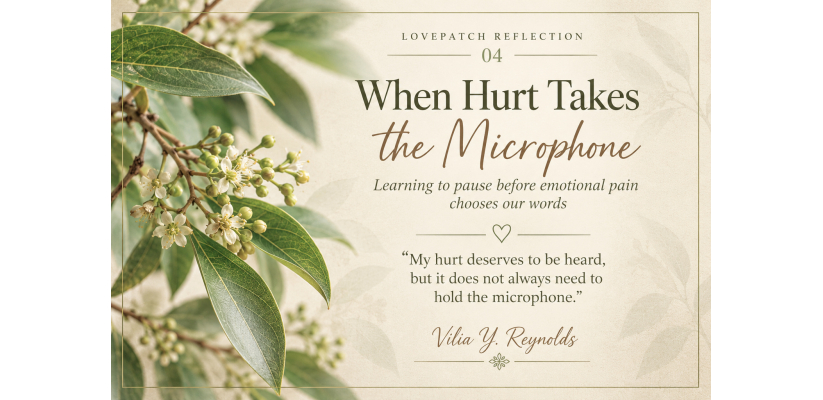
Learning to pause before emotional pain chooses our words
By Vilia Y. Reynolds
We are often encouraged to speak our minds.
To express ourselves. To be honest about our feelings. To say when something hurts, when we disagree, or when someone has crossed a personal boundary.
And there is nothing wrong with that.
Our thoughts matter. Our feelings deserve acknowledgement. Our voices deserve to be heard.
But perhaps there is another question worth asking before we speak.
Am I speaking from understanding, or am I allowing my hurt to hold the microphone?
When Our Emotions Become Louder Than Our Words
Sometimes an interaction touches something tender within us.
A criticism. A disagreement. A disappointing response. A feeling of being rejected, misunderstood, dismissed or disrespected.
And suddenly, what began as an ordinary conversation feels deeply personal.
Our emotions rise.
We feel the need to explain ourselves, defend our intentions, correct the other person or make sure they understand how much they have hurt us.
And then we speak.
Sometimes quickly.
Sometimes sharply.
Sometimes with words we would have chosen differently if we had given ourselves a moment.
We tell ourselves, I'm just speaking my mind.
But are we?
Or is our hurt speaking on our behalf?
When we feel threatened or overwhelmed, our body's stress response can make it more difficult to think calmly and consider another perspective.
We sometimes hear this described as an amygdala hijack — a way of explaining how strong emotional reactions can temporarily overshadow more deliberate thinking.
It does not mean our feelings are wrong.
It means that what we feel and how we choose to express it are not necessarily the same thing.
The Space Between Feeling and Speaking
We often hear people say that someone needs to put a filter on their words.
But what does that really mean?
A filter should not become another wall behind which we hide our feelings.
It does not mean keeping quiet when something matters.
It does not mean pretending we are not hurt, avoiding difficult conversations or allowing someone to treat us disrespectfully.
Perhaps a healthier understanding of a filter is simply this:
The filter is the space between what I feel and what I say.
That small space gives me an opportunity to recognise what is happening within me before I respond to what is happening around me.
I can acknowledge that I feel hurt without immediately accusing someone of hurting me intentionally.
I can recognise my anger without allowing it to determine the tone of my voice.
I can experience disappointment without turning it into rejection.
And I can disagree without making the other person my enemy.
Sometimes the most important conversation begins quietly within ourselves.
What am I actually feeling?
What has made this interaction so important to me?
What am I trying to communicate?
Do I want to be understood, or do I simply want the other person to feel how deeply I have been hurt?
These are not always comfortable questions.
But they can become valuable moments of self-awareness.
When Curiosity Replaces Reaction
Sometimes, instead of immediately making a statement, we can begin with a question.
Help me understand what you meant.
What was happening for you at that moment?
Is there something here I may not understand?
An exploratory question creates room for understanding.
It allows us to listen without necessarily agreeing.
To consider another perspective without surrendering our own.
And to recognise that someone's words or actions may not always carry the meaning we initially give them.
Of course, not every conversation is safe or appropriate to continue. Sometimes a clear boundary, a pause or stepping away is the wiser choice.
But where a conversation is safe enough to explore, curiosity may open a door that immediate reaction would have closed.
We can still speak our truth.
We can still express disagreement.
We can still say, That hurt me.
We can still establish boundaries.
The difference is that we are learning to respond with greater awareness rather than allowing emotional pain to choose our words.
Choosing Who Holds the Microphone
I often think about how much can change in the small space between feeling something and saying something.
Perhaps this is where emotional resilience begins to grow.
Not by becoming less sensitive.
Not by pretending that nothing affects us.
And not by silencing the parts of ourselves that have been hurt.
But by learning that our emotions can inform us without having to control us.
In Christian living, this also invites us to consider the gentleness, patience, humility and love we are encouraged to put on.
We do not have to deny our emotions to practise these qualities.
Rather, we can allow them to shape how we respond, even when conversations are difficult.
Perhaps the movement is as simple as:
FEEL → PAUSE → EXPLORE → UNDERSTAND → CHOOSE → SPEAK
I feel what is happening within me.
I pause before reacting.
I explore what has touched me.
I seek to understand what is happening.
I choose how I wish to respond.
And then I speak.
Not because my hurt no longer matters.
But because my words matter too.
“My hurt deserves to be heard, but it does not always need to hold the microphone.”
A Moment to Explore
When you find yourself reacting strongly in a conversation, what might change if you gave yourself a moment to understand your hurt before allowing it to choose your words?
LovePatch Reflections | CRCTC
Embracing Change. Choosing Your Way Forward.
Vilia Y. Reynolds