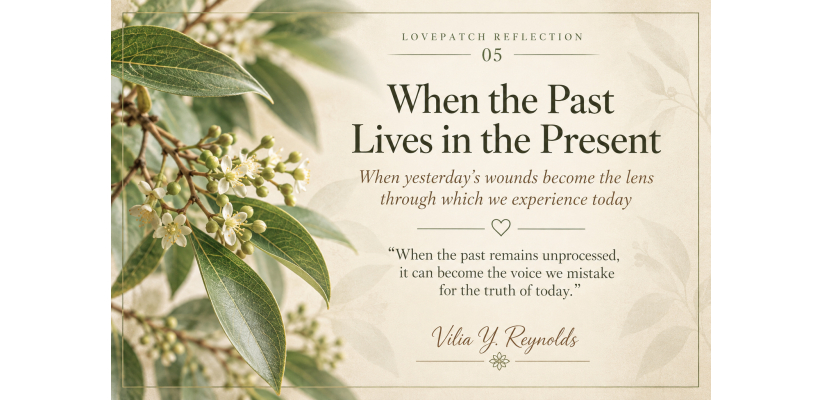
When the wounds of yesterday find their way into the relationships of today.
By Vilia Y. Reynolds
Sometimes the most difficult part of living with unresolved trauma is that yesterday does not always remain in yesterday.
It finds its way into today.
Into our conversations, our relationships, our expectations, and sometimes even into moments that should feel safe.
The past does not have to be consciously remembered to influence how someone experiences the present.
A word, a facial expression, an unexpected silence, or a slight change in someone's tone of voice may awaken an old sense of danger.
And suddenly, yesterday interrupts today.
Someone who was laughing moments earlier may become quiet and withdrawn. Someone who longs to be loved may push away the very person offering affection. An innocent question may be received as criticism, while a simple disagreement may awaken feelings of rejection or fear.
To those around them, these reactions may seem confusing, unreasonable, or unpredictable.
But what if that person is responding not only to what is happening now, but also to what life has taught them to expect?
When Two People Experience the Same Moment Differently
Imagine two people having an ordinary conversation.
One is speaking from the reality of today.
The other, without necessarily recognising it, may be hearing the conversation through the pain of yesterday.
One hears a question. The other hears an accusation.
One experiences silence as a moment to think. The other experiences it as abandonment.
One sees a disagreement. The other anticipates rejection.
Neither may fully understand why the conversation has suddenly changed.
And this is often where misunderstanding begins.
The person carrying the wound may feel threatened, while the person standing beside them feels confused, rejected, or unfairly accused.
Both may walk away hurting.
The Wound Beneath the Response
Trauma can influence how a person recognises safety, interprets experiences, and responds to perceived danger.
What once helped someone endure an overwhelming experience may become a familiar way of protecting themselves, even when the present circumstances are different.
They may withdraw, become defensive, anticipate rejection, or struggle to trust another person's intentions.
These responses do not necessarily reflect who they are or what they truly desire.
Sometimes what appears to be an unpredictable person is someone living with an unpredictable sense of safety.
The soul may long for what the wound has learned to fear.
A person may long for closeness yet fear vulnerability. They may desire peace yet remain watchful for conflict. They may deeply value a relationship yet find themselves responding in ways that create distance.
Not every difficult reaction is rooted in trauma, and understanding a wound does not excuse behaviour that harms others.
But recognising the possibility of an unseen wound invites us to approach one another with greater understanding.
Looking Beyond What We See
There is a difference between excusing someone's behaviour and seeking to understand it.
Understanding does not remove responsibility.
Compassion does not require us to abandon healthy boundaries.
And love does not mean accepting repeated hurt.
Yet compassion may change the way we respond.
Instead of asking only, "Why are you behaving this way?" we may begin to wonder what has made this moment feel threatening.
Instead of interpreting every withdrawal as rejection, we may recognise that distance can sometimes feel safer than closeness.
And instead of meeting every defensive response with another defensive response, we may discover opportunities for patience, clarity, and understanding.
Colossians 3:12–14 reminds us of compassion, kindness, humility, gentleness, patience, forgiveness, and love.
These qualities invite us to see beyond the immediate behaviour without losing sight of truth, responsibility, or healthy relationships.
Perhaps one of the greatest challenges in our relationships is learning to recognise that two people may be standing in the same moment while experiencing it very differently.
We often respond to the behaviour we can see, without understanding the wound we cannot see.
When Yesterday No Longer Has to Determine Today
The experiences that have wounded us cannot simply be erased.
But they do not have to determine every response, every relationship, or every expectation we carry into the future.
Through understanding, appropriate support, and opportunities to process painful experiences, we can gradually learn to distinguish between what happened then and what is happening now.
We may discover that not every silence means abandonment.
Not every disagreement means rejection.
And not every unexpected change means something painful is about to happen.
Yesterday may remain part of our story.
But it does not have to write every chapter that follows.
A Moment to Explore
When something in the present awakens a strong response within me, what might that response be telling me about an experience from my past?
Vilia Y. Reynolds | LovePatch Reflections | CRCTC
Compassionate reflections on trauma, healing, and understanding.