Understanding the difference between grief and trauma
By Vilia Y. Reynolds
Sometimes we believe that because emotional pain has returned, we must not have worked through our grief properly.
We begin to wonder why something still hurts. Why certain memories still overwhelm us. Why, after travelling so far along the road of bereavement, we sometimes feel as though we are standing in the same place again.
But perhaps the pain is asking us to consider something different.
Could it be that we have processed much of our grief, but are still carrying trauma?
When Grief and Trauma Walk Together
Grief and trauma often accompany one another, but they are not necessarily the same.
Grief is the sorrow of losing someone we love. It involves adjusting to their absence, finding our way through unfamiliar days and gradually learning to live with a love that no longer has the same physical presence.
Trauma may carry something different.
It may hold the shock of what happened, the fear we experienced, the helplessness we felt or the painful circumstances surrounding the loss.
Sometimes a bereavement also awakens wounds from earlier experiences of rejection, abandonment, violation or emotional suffering.
We may have made peace with the reality of the loss while still carrying the emotional impact of what happened around it.
And when that pain returns, we may mistakenly believe that we have failed to grieve.
Yet returning emotional pain does not automatically mean that our grief has become prolonged or that we are moving backwards.
Sometimes it is simply another part of our story asking to be heard.
When the Pain Beneath the Grief Begins to Speak
There is a difference between missing someone and feeling overwhelmed by the circumstances of losing them.
We may remember a loved one with tenderness, gratitude and sadness, yet still experience intense fear, anger, guilt or helplessness when something reminds us of a painful event.
Sometimes the grief becomes quiet enough for the trauma beneath it to become more noticeable.
This does not mean that every painful memory is evidence of trauma. Nor does it mean that prolonged grief is never a concern.
It simply invites us to recognise that grief and trauma may require different kinds of care.
Instead of immediately asking, Why am I still grieving?, perhaps we can begin asking, What is this pain trying to tell me?
It may reveal an experience that still needs understanding, compassion and appropriate support.
When Emotional Pain Becomes an Offering
There are losses we cannot reverse.
There are wounds we cannot simply think away.
And there are experiences that remain part of our story, no matter how much time has passed.
Yet within our Christian journey, we may discover another way of approaching the pain we carry.
We can bring it before God as an offering.
Not because suffering was good. Not because we are expected to endure it silently. And certainly not because asking for help would demonstrate a lack of faith.
But because even the most painful parts of our stories can be placed honestly before Him.
Lord, this happened to me. It hurt me. I cannot change what happened, but I do not want my pain to remain without meaning. Meet me here, and help something life-giving grow from what I have endured.
An offering does not require us to pretend that the wound has disappeared.
Sometimes it becomes the beginning of a different relationship with our pain.
What once left us feeling alone may deepen our compassion for another person who is suffering.
What we have endured may help us recognise the quiet brokenness in someone else’s heart.
We may find ourselves able to sit beside another person, not with easy answers, but with understanding.
And perhaps we can gently say:
I know something of this road. I cannot walk it for you, but I can walk beside you.
Our suffering need not define us. Yet, in God’s hands, what we have endured may eventually become part of how we offer compassion, presence and hope to others.
A Different Question, A Gentle Invitation
If you have already worked through much of your grief, but still experience emotional pain, do not be too quick to question the progress you have made.
Perhaps you are not beginning your grieving journey all over again.
Perhaps another part of your experience still needs attention.
And perhaps healing begins when we allow ourselves to distinguish between the person we miss, the experiences that wounded us and the care we still need.
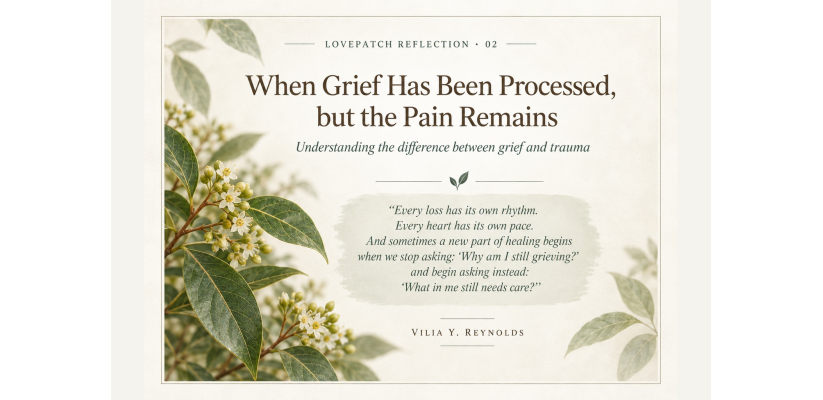
Every loss has its own rhythm. Every heart has its own pace. And sometimes a new part of healing begins when we stop asking, “Why am I still grieving?” and begin asking instead, “What in me still needs care?”
A Moment to Explore
When emotional pain returns after a loss, what might it be inviting you to understand about the grief you have carried, the experiences that have wounded you, and the care you may still need?
LovePatch Reflections | CRCTC
Embracing Change. Choosing Your Way Forward.
Vilia Y. Reynolds