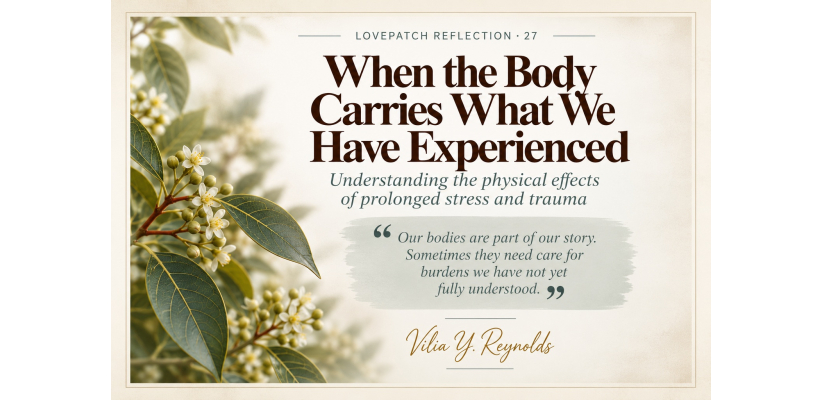
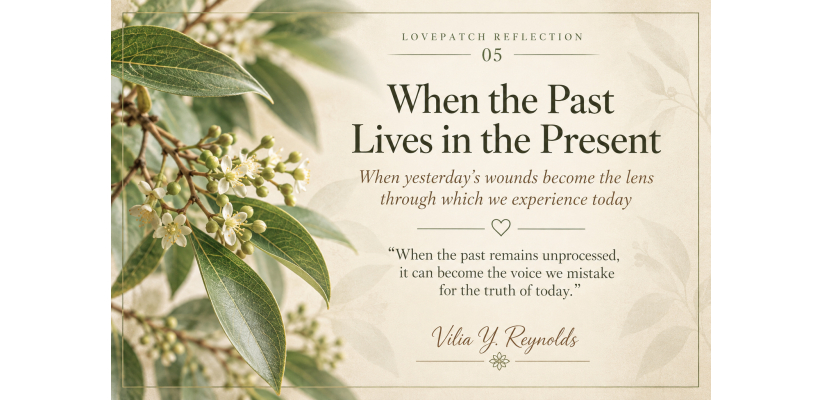
When yesterday’s wounds become the lens through which we experience today
By Vilia Y. Reynolds
Sometimes we react to the present as though we are still living in the past.
A conversation unsettles us. A tone of voice makes us defensive. A small disappointment leaves us feeling unusually hurt, threatened or overwhelmed.
And afterwards we wonder:
Why did I react like that? Why did that affect me so deeply? Why am I behaving in a way I do not fully understand?
This is one of the confusing realities of trauma.
Trauma is not simply something that happened then. When an experience has not been adequately processed and integrated, aspects of it can continue to influence how we experience now.
What happened in the past may no longer be taking place, yet something within us may still respond as though it is.
When the Present Feels Bigger Than the Present
Sometimes our reactions seem larger than the moment itself.
We may become angry, fearful, withdrawn, defensive or ashamed without immediately understanding why.
The difficulty is that the original source of the reaction is not always obvious to conscious awareness.
The nervous system can respond before the thinking mind has an explanation.
And when we cannot understand our own response, we often try to reason it out.
We explain. We justify. We deny. We challenge. We create interpretations that help us make sense of what feels uncomfortable or confusing.
Not necessarily because we are unwilling to change, but because the mind naturally tries to create meaning and safety around what it cannot yet understand.
Over time, these explanations can become fixed beliefs.
We may begin to assume that people will reject us, misunderstand us, control us, disappoint us or leave us.
And slowly, without meaning to, we start seeing the present through the lens of the past.
This does not mean every strong reaction is caused by trauma, nor does it mean that every present difficulty can be explained by a hidden wound.
But sometimes the emotional weight of a moment points beyond the moment itself.
When Protection Becomes a Way of Seeing
As these protective patterns settle in, they can begin to shape more than behaviour.
They can influence how we see ourselves, how we interpret other people and how we relate to God.
We may become ashamed of reactions we cannot explain.
We may hide what feels confusing. We may protect what feels too vulnerable to examine. We may blame others, become defensive or withdraw into silence.
And sometimes we build an entire way of living around protecting ourselves from something we cannot yet name.
It is as though a part of our story has been placed behind the bars of trauma — hidden from clear understanding, yet still influencing the way we feel, interpret and respond to life.
What began as protection may eventually become a lens.
And when that happens, the past does not merely remain in memory.
It begins to colour the meaning we give to the present.
Where Healing Begins
Healing often begins, not with self-condemnation, but with curiosity.
Instead of asking, What is wrong with me? we may begin to ask:
What is happening in me? What might my response be trying to communicate? Is this reaction only about what is happening now? What belongs to the past, and what belongs to the present?
Trauma-informed work does not shame us for our responses.
It helps us become more aware of them.
It invites us to gently separate what happened then from what is happening now.
Sometimes that process includes understanding a past experience more clearly. Sometimes healing happens without recovering every detail. What matters is that increasing awareness helps us recognise when yesterday may be shaping today's interpretations.
When awareness begins to enter the places where there was once only confusion, we become more able to choose our responses rather than simply repeating them.
We begin to notice when fear is speaking. When shame is taking over. When an old wound is trying to define a new moment.
And gradually, we learn something deeply restorative:
The past deserves to be understood. But the past does not have to become the lens through which we interpret every present experience.
Coming Back to the Present
Perhaps this is part of restoration.
Coming back to the present. Coming back to ourselves. Coming back into relationship.
And ultimately, coming back into the presence of God — with spirit, soul and body.
We do not heal by pretending the past never mattered.
We heal by allowing what has remained unprocessed to come into the light with gentleness, honesty and care.
As this happens, our present life no longer has to be ruled by meanings shaped only by old pain.
We begin to recognise where the past ends and where the present begins.
And in that growing awareness, something changes.
We may still remember. We may still feel. We may still need time.
But we are no longer completely at the mercy of what we do not understand.
“When the past remains unprocessed, it can become the voice we mistake for the truth of today.”
The past may have shaped your story.
It does not have to write your future.
A Moment to Explore
When your response to a present situation feels unusually strong, what might help you gently discern what belongs to today, and what may still be echoing from yesterday?
LovePatch Reflections | CRCTC
Compassionate reflections on trauma, healing, and understanding.
Vilia Y. Reynolds