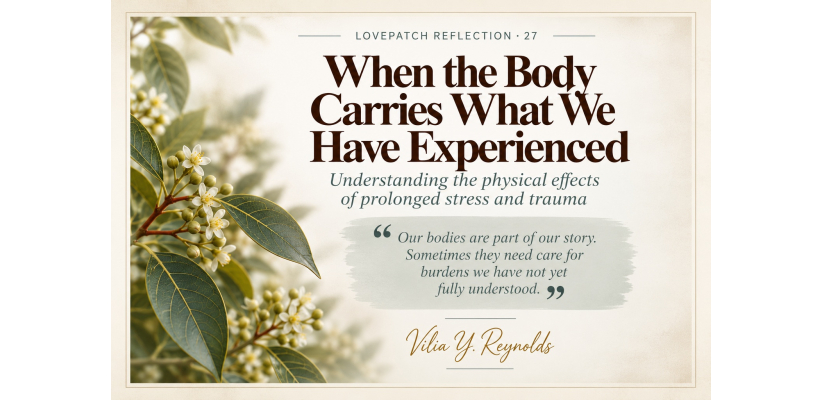
Understanding the physical effects of prolonged stress and trauma
By Vilia Y. Reynolds
Sometimes our bodies seem to be telling a story we do not yet understand.
We feel exhausted, even after resting.
Our shoulders remain tense.
Our stomach becomes unsettled.
We struggle to sleep.
Our hearts seem to race when something unexpected happens.
And sometimes we wonder why ordinary responsibilities suddenly require so much effort.
We may tell ourselves:
I should be coping better.
Why can't I simply relax?
What is wrong with me?
But perhaps there is another question worth considering.
What might my body be responding to, and what kind of care does it need?
When Stress Becomes More Than a Feeling
We often speak about stress as though it exists only within our thoughts and emotions.
We worry.
We feel overwhelmed.
We become frustrated or afraid.
Yet stress also involves physical processes.
When we encounter challenging or threatening circumstances, our bodies respond through interconnected systems that help us adapt.
Our attention may become more focused.
Our hearts may beat faster.
Our muscles may become tense.
Our breathing may change.
Hormones and other chemical messengers help coordinate these responses.
These processes are not inherently harmful.
They are part of our capacity to respond to life's demands.
But when stress becomes prolonged, or when earlier experiences leave us particularly sensitive to possible threats, we may find ourselves experiencing physical tension and heightened alertness more frequently.
Sometimes we recognise this immediately.
At other times, we become so accustomed to the experience that we barely notice how much energy it requires.
And perhaps this is one reason why emotional difficulties and physical experiences can sometimes seem so closely connected.
When the Body Remains on Alert
For some people, traumatic experiences can influence the way they respond to reminders of danger.
An unexpected sound may awaken a strong startle response.
A particular environment may bring feelings of unease.
A difficult conversation may be accompanied by muscle tension or a racing heart.
Someone may feel physically unsettled before fully recognising what has made them anxious.
These responses can involve changes in attention, emotional processing and the body's systems for responding to stress.
But they do not mean that every person who experiences trauma will remain constantly activated.
Nor does a strong physical reaction necessarily indicate unresolved trauma.
Many factors can influence how we experience bodily sensations, including sleep, illness, medication, everyday demands and current circumstances.
This is why curiosity matters.
Rather than immediately assuming that our physical experiences are evidence of emotional wounds, we can begin exploring the broader picture.
What is happening in my life?
When do I notice these sensations?
What physical or emotional demands have I been carrying?
Is there something that needs medical attention?
Understanding our experiences involves remaining open to different explanations.
When Physical Symptoms Need More Than Reassurance
Sometimes people experiencing prolonged stress notice changes in sleep, digestion, appetite, concentration or physical comfort.
Muscle tension may contribute to discomfort.
Stress can influence digestive functioning.
Sleep difficulties may leave us feeling physically exhausted and emotionally less able to manage everyday demands.
But these experiences are not unique to trauma.
Headaches, fatigue, digestive problems, pain and other physical symptoms can have many possible causes.
Some may involve medical conditions that require investigation or treatment.
Others may be influenced by several interacting factors.
We should therefore be careful about telling someone:
It's only stress.
Your body is holding trauma.
You just need to process what happened.
Although these statements may be intended to reassure, they can oversimplify a person's experience.
Sometimes appropriate medical care is essential.
Sometimes psychological support may be helpful.
And sometimes both are needed.
A compassionate approach does not require us to choose between physical and emotional explanations before we have enough information.
It allows us to consider the whole person.
When We Misunderstand Our Own Responses
One of the difficulties with unexplained physical discomfort is the meaning we may begin attaching to it.
We become frustrated with ourselves.
We judge our limitations.
We compare our abilities with those of others.
And sometimes we begin believing that our physical struggles reveal something about our character.
I am weak.
I am not resilient.
I should be able to do more.
But physical symptoms are not moral failures.
Needing rest does not mean we lack determination.
Experiencing anxiety does not mean we lack courage.
And seeking medical or psychological support does not mean we have failed to manage our lives.
Sometimes the most meaningful change begins when we stop condemning ourselves for what we are experiencing.
Instead, we become curious.
We begin noticing patterns.
We seek appropriate understanding.
And we recognise that compassion is not the opposite of responsibility.
It can help us respond more wisely to what needs attention.
When Healing Involves the Whole Person
Within my Christian understanding, I recognise that care and healing concern the whole person.
Our physical experiences, thoughts, emotions, relationships, beliefs and spiritual lives can influence our experience of everyday life.
This does not mean that every illness has an emotional or spiritual cause.
Nor does it mean that prayer or trauma counselling should replace appropriate medical treatment.
Rather, I believe faith can provide hope, meaning and encouragement alongside responsible, evidence-informed care.
Sometimes support may involve counselling.
Sometimes medical assessment.
Sometimes rest, healthier routines or practical changes in our circumstances.
For some people, grounding exercises and carefully chosen body-based practices may help them feel more settled.
Others may benefit from structured psychological treatment that addresses distress linked to traumatic experiences.
Different people need different forms of care.
And no single approach guarantees recovery from every difficulty.
Perhaps the invitation is not to search for one explanation that accounts for everything we experience.
Perhaps it is to become more attentive to the many ways we may need care.
When Understanding Replaces Self-Blame
There is something meaningful about discovering that a response we have been judging may have an understandable explanation.
Perhaps our tension increases during periods of uncertainty.
Perhaps our sleep becomes disturbed when responsibilities feel overwhelming.
Perhaps particular situations remind us of earlier experiences.
Or perhaps a medical condition is contributing to symptoms we have been attributing entirely to stress.
Understanding these possibilities can help us make more informed choices.
We can begin recognising when we need rest.
When we need support.
When we need professional assessment.
And when we may benefit from developing different ways of responding to life's demands.
“Our bodies are part of our story. Sometimes they need care for burdens we have not yet fully understood.”
We do not have to interpret every physical sensation as evidence of trauma.
And we do not have to dismiss the possible influence of stressful experiences simply because their effects are not immediately visible.
We can remain open to understanding.
We can seek appropriate help.
And we can approach ourselves with greater compassion.
Because the question is not simply whether our physical experiences are connected to our past.
It is whether we are listening carefully enough to recognise what needs attention today.
Sometimes healing begins with emotional understanding.
Sometimes it begins with medical care.
Sometimes it involves learning to respond differently to stress.
And sometimes it begins with the recognition that we deserve care without first having to explain or justify every difficulty we experience.
A Moment to Explore
When you notice physical discomfort, tension or exhaustion during a demanding season, how might you respond with greater curiosity and compassion while remaining attentive to the possibility that your body needs appropriate medical or emotional care?
LovePatch Reflections | CRCTC
Embracing Change. Choosing Your Way Forward.
Vilia Y. Reynolds