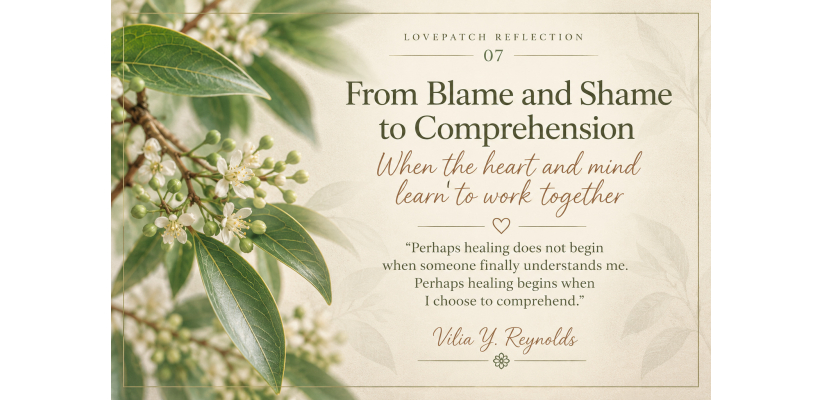
When the heart and mind learn to work together
By Vilia Y. Reynolds
Sometimes we spend so much time wanting someone else to understand us that we forget to ask whether we understand what is happening within ourselves.
We want to be heard.
We want to be seen.
We want someone to recognise our pain, acknowledge our feelings and understand why something has affected us so deeply.
And these are meaningful human needs.
But what happens when we do not understand our own emotional responses?
When we cannot explain why something hurts, why we become defensive, or why a particular situation leaves us feeling rejected, angry or ashamed?
Sometimes, without even recognising it, we begin searching for someone to blame.
And once we have found someone to blame, we may begin expecting them to fix what we have not yet comprehended.
Perhaps this is where an important distinction begins.
The longing to be understood and the willingness to comprehend are not quite the same thing.
When the Heart Wants to Be Understood
One of the meaningful conversations I facilitate with clients involves exploring the relationship between feelings and thinking.
We often use the words understand and comprehend interchangeably.
Yet, for the purpose of this reflection, I find it helpful to distinguish between two experiences.
When someone says:
You don't understand me.
They may not be asking for more information.
They may be expressing something much deeper.
I don't feel heard.
I don't feel seen.
I don't feel accepted.
I don't feel safe.
Their words carry an emotional longing for connection, acknowledgement and belonging.
This is what I describe as the heart's desire to be understood.
Comprehension, in contrast, invites us to step into a different process.
It asks us to pause, become curious, consider what is happening and seek a fuller picture before making choices.
The two belong together.
We need both emotional acknowledgement and thoughtful discernment.
When the Heart Covers the Mind
To explore this relationship, I sometimes use a simple demonstration.
I make two fists.
My left fist represents the mind — our capacity to reason, reflect, evaluate, discern and make intentional choices.
My right fist represents the heart — our emotional experiences, including fear, anger, guilt, shame, grief, disappointment and pain.
Then I gently place my right fist over my left.
It becomes a simple picture of what can happen when emotions feel overwhelming.
Our emotional experience may temporarily overshadow our ability to think clearly.
The mind has not stopped working.
We have not lost our ability to reason.
But when we feel threatened, rejected or deeply hurt, it can become more difficult to consider the situation calmly and from different perspectives.
Our feelings become so prominent that they begin influencing the meaning we give to what is happening.
And sometimes, this is where blame and shame enter the conversation.
When Blame and Shame Become Our Explanations
Shame may whisper:
There is something wrong with me.
Blame may respond:
There is something wrong with you.
Both can become ways of interpreting an experience that we have not yet fully understood.
Shame turns our attention inward, sometimes leading us to question our worth.
Blame directs our attention outward, sometimes making another person responsible for explaining or resolving our emotional pain.
Neither response necessarily helps us see the whole picture.
And when we cannot comprehend what is happening within us, blame may offer a quick explanation.
You made me feel this way.
You are the reason I am unhappy.
If only you would change, I would be fine.
Sometimes another person genuinely has contributed to our pain, and recognising harmful behaviour is important. Taking responsibility for our responses does not mean accepting blame for someone else's actions.
But even when another person has hurt us, there remains an important part of the journey that belongs to us.
Learning to recognise what we feel, what we believe, what we need and what choices remain available.
Blame may offer temporary emotional relief.
Comprehension offers the possibility of greater clarity.
When Curiosity Makes Room for Comprehension
Perhaps healing begins when we gently lift the heart from covering the mind.
Not because our emotions are wrong.
Not because our feelings no longer matter.
And certainly not because we must suppress what hurts.
But because our emotions deserve the companionship of a clear and discerning mind.
Instead of immediately blaming ourselves or another person, we can begin asking different questions.
What am I feeling?
What happened that contributed to these feelings?
What assumptions am I making?
What might I not yet be seeing?
What choices are available to me now?
These questions do not dismiss emotional pain.
They invite us to approach it with curiosity.
Comprehension helps us place our feelings within a broader context.
It allows us to acknowledge our emotional experiences without allowing them to become our only source of truth.
As comprehension grows, defensiveness may begin to soften.
Curiosity can replace immediate accusation.
Self-awareness can replace confusion.
And responsibility can begin to replace the expectation that someone else must resolve everything happening within us.
When the Heart and Mind Work Together
There is one final distinction I find particularly meaningful.
We may spend years waiting for someone to understand us.
Waiting for an apology.
Waiting for acknowledgement.
Waiting for someone to finally recognise what we have experienced.
And sometimes that acknowledgement is deeply important.
But our own journey towards comprehension does not necessarily have to wait.
We can begin exploring what is happening within us, even when another person is unable or unwilling to understand.
In Christian living, this invites us towards the renewal of our minds, while continuing to acknowledge the importance of our hearts.
We need not choose between feeling and thinking.
Our emotions can alert us that something matters.
Our minds can help us explore why it matters and how we wish to respond.
And together, they can guide us towards choices shaped by truth, compassion, humility and love.
When the heart and mind begin working together rather than competing for control, we create room for a different response.
We can move beyond blame without denying harm.
We can move beyond shame without denying responsibility.
And we can begin responding to life with greater understanding of ourselves and others.
“Perhaps healing does not begin when someone finally understands me. Perhaps healing begins when I choose to comprehend.”
A Moment to Explore
When you feel misunderstood, hurt or defensive, what might change if you gently explored what is happening within you before deciding who or what is responsible for your pain?
LovePatch Reflections | CRCTC
Embracing Change. Choosing Your Way Forward.
Vilia Y. Reynolds