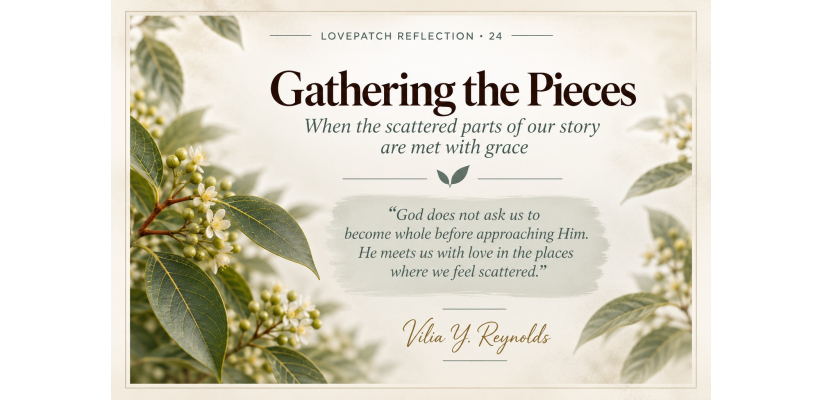
When the scattered parts of our story are met with grace
By Vilia Y. Reynolds
Sometimes life leaves us feeling as though something within us has been scattered.
Our thoughts.
Our emotions.
Our memories.
Our sense of direction.
Even the familiar understanding of who we are.
A painful experience may change the way we see ourselves.
A loss may interrupt everything we once considered certain.
A betrayal may leave us questioning what we believed about trust.
And sometimes, after carrying more than we ever imagined possible, we begin wondering whether anything whole can emerge from what feels so broken.
We look at the scattered pieces of our lives and quietly ask:
Where do I begin?
How do I put everything together again?
Will I ever feel like myself?
Perhaps the gentlest invitation is not to gather every piece before taking another step.
Perhaps it is to discover that we do not have to arrive before God already restored.
When Life Leaves Us Feeling Scattered
There are seasons in which life changes so dramatically that our familiar ways of understanding ourselves no longer seem sufficient.
We may continue working, caring for others and fulfilling responsibilities while privately feeling uncertain or overwhelmed.
Others may see someone who is coping.
But within our experience, something feels different.
We may struggle to make sense of what happened.
We may find ourselves grieving what we have lost.
We may feel disconnected from the person we once believed ourselves to be.
Sometimes we try to push these experiences aside.
We tell ourselves to be stronger.
To move forward.
To stop thinking about what happened.
To become the person we were before.
But healing does not always involve returning to an earlier version of ourselves.
Sometimes it involves learning how to live meaningfully with a story that has changed.
And perhaps this is where the image of gathering becomes important.
Not because our lives are literally broken into pieces.
But because painful experiences can leave us feeling as though important parts of our story are difficult to hold together.
When Jesus Said, “Gather the Fragments”
In John 6, we read about Jesus feeding a large crowd.
After everyone had eaten, Jesus instructed His disciples to gather the remaining food so that nothing would be wasted.
John 6:12 records His instruction:
“Gather up the fragments that remain, so that nothing is lost.”
Within its biblical setting, Jesus is speaking about the food remaining after the miraculous feeding.
Yet when I reflect on those words, I find a meaningful picture of God's care.
Gather what remains.
Do not overlook what is left.
Do not assume that what appears small or scattered has no value.
This is a devotional application of the passage rather than its original meaning.
But it invites me to consider how easily we dismiss parts of our own stories.
We may wish that certain experiences had never happened.
We may feel ashamed of how we responded.
We may regret decisions we made while frightened, overwhelmed or uncertain.
And sometimes we begin believing that the difficult parts of our lives have made us less valuable.
But perhaps grace invites us to approach our stories differently.
Not by pretending every experience was good.
And not by insisting that every painful event must have happened for a reason.
Rather, by recognising that suffering does not place us beyond God's love or care.
When God Meets Us in the Scattered Places
Throughout Scripture, we encounter the image of God gathering, caring for and restoring His people.
Psalm 147 describes the Lord gathering the dispersed people of Israel, healing the brokenhearted and binding up their wounds.
Ezekiel 34 portrays God as a shepherd who seeks His scattered sheep and brings them to safety.
These passages arise from particular historical and spiritual circumstances.
Yet together they reveal a biblical theme of God's attentive care for those who are vulnerable, displaced or suffering.
For me, this offers a gentle reminder.
God does not ask us to become whole before approaching Him.
We can come with unanswered questions.
With grief.
With disappointment.
With uncertainty.
With memories that still hurt.
With parts of our story we do not yet understand.
We do not need to hide our vulnerability behind the appearance of being strong.
And we do not need to pretend that everything has already been resolved.
Perhaps one of the most meaningful expressions of faith is the willingness to come before God honestly.
Lord, this is where I am.
This is what has happened.
This is what I am still carrying.
Help me recognise what needs care.
When Gathering Becomes Part of Healing
Healing is not always a dramatic event.
Sometimes it begins with a conversation.
A moment of understanding.
A memory that no longer carries the same intensity.
A feeling we finally recognise.
A boundary we learn to establish.
Or an opportunity to experience safety and connection again.
Sometimes healing includes appropriate trauma-informed counselling.
Sometimes it involves grief support, medical care, meaningful relationships or practical changes in our circumstances.
And sometimes the most important step is recognising that we do not have to navigate everything alone.
The image of gathering invites us to approach our experiences with patience.
We do not need to force ourselves to revisit every painful memory.
We do not have to uncover every hidden part of the past.
Nor must we understand everything before meaningful recovery becomes possible.
Instead, we can begin noticing what needs attention today.
We may discover strengths we had overlooked.
We may recognise how earlier experiences shaped our responses.
We may begin developing a more compassionate understanding of ourselves.
And gradually, what once felt impossible to hold may become easier to approach with understanding and care.
When Restoration Looks Different from Before
Perhaps one of the difficulties with the word restoration is that we sometimes imagine it means returning everything to exactly the way it once was.
But some experiences change us.
A loved one cannot always be brought back.
An earlier season cannot be relived.
And certain losses cannot simply be reversed.
Yet a meaningful life can still develop beyond those experiences.
We may discover renewed purpose.
Different forms of connection.
Greater understanding.
Or the ability to approach ourselves and others with more compassion.
This does not mean we must be grateful for what harmed us.
Nor does it mean that every painful experience leads to personal growth.
It simply means that the possibility of meaningful change is not always lost because something difficult has happened.
Within my Christian understanding, I believe God's love remains present throughout that journey.
Not only when we feel strong.
Not only when we have answers.
But also when we feel uncertain, overwhelmed or scattered.
God does not ask us to become whole before approaching Him. He meets us with love in the places where we feel scattered.
Perhaps the invitation is not to gather every piece of our lives through our own strength.
Perhaps it is to begin recognising what remains.
What still matters.
What needs care.
What may be ready for understanding.
And what we can gently entrust to God.
Because the scattered places of our lives do not have to be places of shame.
They can become places where we experience compassion, receive support and discover that our story is not finished.
And perhaps, piece by piece, we begin finding a different kind of wholeness.
Not because everything has returned to the way it was.
But because we are learning to live with greater understanding, connection, hope and grace.
A Moment to Explore
When you consider the parts of your life that feel scattered or unfinished, what might change if you approached them with compassion rather than expecting yourself to have everything together before seeking care or bringing them before God?
LovePatch Reflections | CRCTC
Embracing Change. Choosing Your Way Forward.
Vilia Y. Reynolds