When Love Becomes Management
By Vilia Y. Reynolds
Sometimes relationships do not fall apart because of one dramatic event.
Sometimes they slowly lose their warmth through hundreds of ordinary moments.
A correction instead of encouragement.
A decision made for someone instead of with them.
A reminder that sounds more like criticism.
A conversation that never happens.
And somewhere along the way, two people who once felt deeply connected begin to feel increasingly distant.
They may still share a home, responsibilities, routines and family occasions.
Yet emotionally, something has begun to change.
This is what I call Silent Relationship Erosion.
When Caring Becomes Controlling
One of the quieter contributors to relationship erosion can be micromanagement.
It does not always begin with a desire to control another person.
Sometimes it begins with anxiety.
One partner may feel responsible for keeping everything together.
They organise.
They remind.
They correct.
They supervise.
They anticipate problems and try to prevent mistakes.
What may have started as care gradually becomes a need to manage not only the circumstances of everyday life, but also the person they love.
And often, they do not recognise what is happening.
They may believe they are being helpful, protective or responsible.
But intentions and impact are not always the same.
The partner receiving this constant guidance may begin hearing a very different message.
You don't trust me.
You don't believe I am capable.
My decisions are never quite good enough.
What one person experiences as care, the other may experience as criticism or a loss of personal freedom.
And slowly, trust begins to weaken.
When Emotional Distance Becomes a Quiet Grief
Trust is one of the quiet foundations of emotional intimacy.
When someone no longer feels trusted, respected or heard, they may begin to withdraw.
Not always because they have stopped loving.
Sometimes because something within the relationship has become painful.
And this is where another emotion may quietly enter.
Grief.
Not necessarily the grief that follows death.
But the grief of no longer feeling seen.
The grief of wondering whether your thoughts, abilities or decisions still matter.
The grief of missing the emotional connection you once experienced with someone who is still beside you.
This kind of grief may not have a name.
It may simply become silence.
Some people stop expressing their opinions.
Others withdraw into work, responsibilities, hobbies or social activities.
Some begin searching for spaces where they feel understood without being corrected.
A conversation with someone who listens attentively may become unexpectedly meaningful.
Not necessarily because they are seeking romance, but because they are longing to feel heard.
Here, I can be myself.
Here, my words have room.
Here, I do not feel constantly evaluated.
When these needs remain unspoken within a relationship, emotional distance can deepen.
When Anxiety and Grief Move in Opposite Directions
And so a painful pattern can develop.
One partner becomes increasingly anxious about losing control or losing the relationship.
The other becomes increasingly distant because they no longer feel emotionally safe or respected.
The more one partner manages, the more the other may withdraw.
And the more the other withdraws, the more anxious the managing partner may become.
One reaches for control.
The other retreats into silence.
Neither may fully understand what is happening beneath their behaviour.
Both may be hurting.
And both may be longing for the same thing.
Connection.
Of course, not all controlling behaviour comes from anxiety, and not all withdrawal comes from grief. Sometimes patterns of control are harmful or coercive and require firm boundaries and appropriate support.
But where anxiety, misunderstanding and emotional disconnection are driving the pattern, recognising what lies beneath the behaviour may offer a different way forward.
When Curiosity Makes Room for Love
Perhaps healing begins when we become curious about what we are experiencing rather than simply reacting to one another's behaviour.
Instead of asking:
Why are you always trying to control everything?
We might gently explore:
What feels so uncertain or frightening that you need to manage it?
And instead of asking:
Why have you become so distant?
We might ask:
What have you been quietly grieving in our relationship?
These questions do not excuse unhealthy behaviour.
They invite understanding.
And understanding can create space for compassion, accountability and change.
Within Christian living, love is not merely something we feel.
It is also something we practise.
Through patience.
Through humility.
Through gentleness.
Through learning to listen without immediately correcting.
And through allowing the person beside us the dignity of having their own thoughts, choices and voice.
Love does not require us to manage another person into becoming who we think they should be.
Sometimes love invites us to loosen our grip and rediscover the person standing before us.
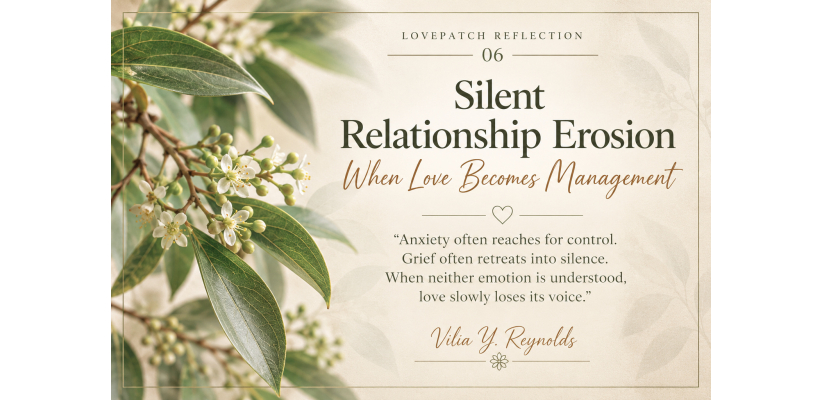
“Anxiety often reaches for control. Grief often retreats into silence. When neither emotion is understood, love slowly loses its voice.”
Perhaps the invitation is not to love harder by trying to control more.
Perhaps it is to listen more carefully.
To recognise the fear beneath the need to manage.
To recognise the sadness beneath the silence.
And to begin creating a relationship where both people can breathe again.
Because when love is no longer confused with management, it has room to become connection.
A Moment to Explore
When you consider the relationships closest to your heart, where might the desire to manage, or the tendency to withdraw, be expressing an emotional need that has not yet been understood?
LovePatch Reflections | CRCTC
Embracing Change. Choosing Your Way Forward.
Vilia Y. Reynolds