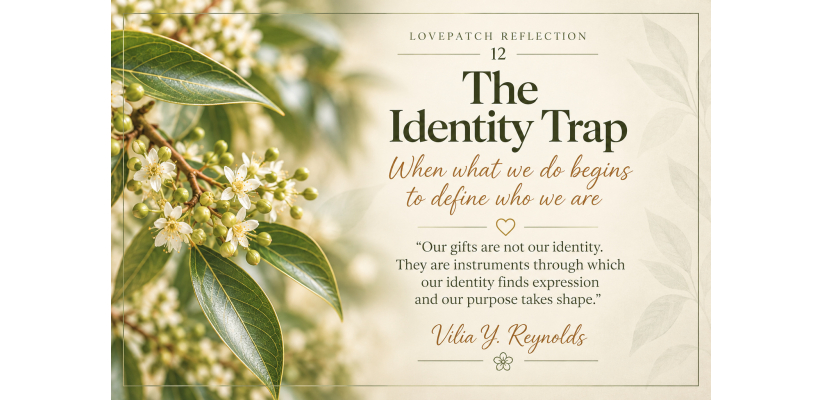
When what we do begins to define who we are
By Vilia Y. Reynolds
Sometimes the greatest detour in life is not choosing the wrong career, but spending years trying to become someone we believe we should be without first discovering who we are.
We pursue qualifications, accept responsibilities, develop skills, build businesses, raise families and establish careers. These can all be meaningful pursuits. Yet somewhere along the way, we may begin measuring our worth by what we accomplish.
We become known by our titles, responsibilities and capabilities.
Then something changes.
A career ends. A relationship changes. Children grow up. Our health or circumstances interrupt our plans.
Suddenly, we face a question we may have avoided for years:
Who am I when what I do is no longer what defines me?
When Achievement Becomes Identity
There is nothing wrong with learning, growing, developing our abilities or pursuing meaningful goals. The difficulty arises when our sense of self becomes dependent on performance.
We may begin to believe that we matter because we are needed, that we succeed because we contribute, or that we belong because others recognise what we do. When a familiar role ends, we can feel as though something essential has been taken from us.
We may then seek another qualification, promotion or opportunity to prove that we are good enough.
Yet accomplishment alone cannot answer the deeper question:
Who am I apart from what I achieve?
When we focus continually on developing our abilities, we may overlook the person using them. Without realising it, we can confuse what we do with who we are.
When Gifts Become Our Definition
We all possess different abilities, strengths, interests and opportunities. Some encourage, teach, lead, create or care for others. Some build, organise, solve problems or bring people together.
These gifts can make meaningful contributions, but they do not tell the whole story of who we are.
Our gifts are tools through which we express ourselves. They are not the measure of our worth.
If we rely on our abilities to establish our significance, we may feel secure only when our contribution is recognised. But our roles and opportunities can change. We may no longer be able to do what we once did, or someone else may perform the same task more effectively.
The loss of a role may be painful, but it does not mean we have lost our value. Our abilities, opportunities and forms of contribution may change without diminishing us.
When Purpose Begins with Who We Are
Perhaps we need to reconsider the questions we ask ourselves.
We often ask:
What should I do next?
Which opportunity should I pursue?
What more can I achieve?
These are important questions, but they may not always be the first ones.
Before deciding what to do, we might explore:
Who am I becoming?
What matters most to me?
What values guide my choices?
How do my gifts reflect the kind of person I desire to be?
Purpose is not necessarily found in a particular title, occupation or accomplishment. It can be expressed through the way we live, love, serve and respond to the circumstances before us.
Sometimes purpose is visible in significant work. Sometimes it is expressed quietly through patience, kindness, caring for someone who cannot repay us, or remaining faithful in responsibilities that nobody else notices.
Our gifts can support meaningful purpose, but purpose is not limited to public achievement.
When Identity Is Renewed in Christ
Within Christian living, identity carries an even deeper meaning. We are invited to understand ourselves not only through our abilities, but through our relationship with Christ.
Colossians 3 offers a meaningful picture of this renewal. Paul encourages believers to put off patterns that no longer belong to their new life and to put on qualities that reflect Christ:
Compassion.
Kindness.
Humility.
Gentleness.
Patience.
Forgiveness.
And above all, love.
These qualities are not qualifications we must earn. They are expressions of the life we are learning to live.
This is particularly meaningful within my Wardrobe of Love™ understanding. We may have spent years wearing identities shaped by expectations, comparison, performance or painful experiences:
I am what I achieve.
I am what others expect of me.
I am only valuable when I am needed.
I must keep proving that I am enough.
Christian growth may involve recognising these old patterns and discovering what we are invited to put on instead: not another achievement, but a way of living that reflects the love and character of Christ.
From this foundation, our gifts can serve rather than define us. They become expressions of purpose, not evidence we must use to establish our significance.
When Our Gifts Find Their Place
There is freedom in recognising that we do not have to prove who we are through everything we accomplish.
We can continue learning, pursue meaningful work, develop our abilities and respond to new opportunities. But our roles can change without erasing our sense of self.
As we move through different seasons, our understanding of purpose may deepen. The question is not simply whether we are using our gifts successfully, but whether we are using them in ways that reflect who we are becoming.
Our gifts are not our identity. They are instruments through which our identity finds expression and our purpose takes shape.
Perhaps the journey forward begins with a different question.
Not only:
What am I capable of doing?
But:
Who am I becoming, and how can what I have been given serve that purpose?
When we no longer ask achievement to prove our worth, our gifts can find their proper place.
A Moment to Explore
When you consider the roles, abilities and achievements that have shaped your life, what might you discover about who you are beyond what you do — and how could that understanding influence the way you use your gifts?
LovePatch Reflections | CRCTC
Embracing Change. Choosing Your Way Forward.
Vilia Y. Reynolds