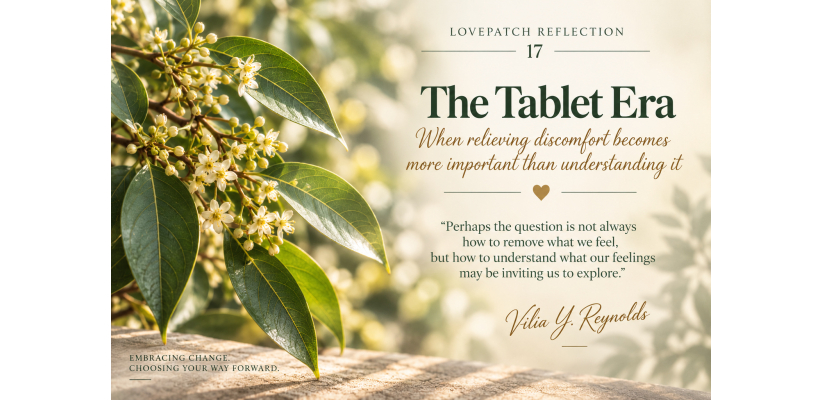
When relieving discomfort becomes more important than understanding it
By Vilia Y. Reynolds
We are living in what I sometimes call The Tablet Era.
Not the digital tablet. The little white tablet.
We live in a world where solutions are often readily available. Can't sleep? Perhaps something will help. Feeling anxious? There may be something to calm us. Feeling exhausted? We search for something that will restore our energy. Struggling to concentrate? We look for something that will improve our focus.
And there is nothing inherently wrong with seeking appropriate treatment or relief. Modern medicine has transformed countless lives. Medication can relieve suffering, support recovery, stabilise serious health conditions and, in many circumstances, save lives.
But sometimes I wonder whether our desire to feel better has become so urgent that we forget to ask why we are feeling the way we do.
Have we become so focused on removing discomfort that we sometimes overlook what it may be inviting us to understand?
When Discomfort Becomes Something to Fix
Life does not always feel comfortable. We experience disappointment, frustration, worry, grief, tiredness and uncertainty. These experiences are part of being human.
Yet sometimes we begin treating every uncomfortable emotion as evidence that something within us is wrong. We search for immediate relief before considering what our experience may be communicating.
Perhaps we are exhausted because we have been carrying too many responsibilities. Perhaps our frustration is revealing a boundary we have repeatedly overlooked. Perhaps our sadness is connected to a meaningful loss. Or perhaps our anxiety deserves further assessment, appropriate treatment and compassionate support.
Not every painful experience is trauma. Not every period of sadness is depression. Not every worried thought indicates an anxiety disorder. And not every difficulty concentrating means someone has ADHD.
But neither should we dismiss persistent or significant difficulties simply because they resemble ordinary human experiences. Sometimes discomfort is part of life. Sometimes it signals a need for attention. Sometimes it is a symptom of a condition that deserves professional care.
The invitation is not to reject relief. It is to become curious about what we are experiencing rather than assuming that every difficulty requires the same response.
When We Forget to Ask What We Are Wearing
Within my Wardrobe of Love™ understanding, I often return to the image of clothing. Every morning, we choose what to wear. But perhaps there is another wardrobe we visit without recognising it: the wardrobe of our attitudes, expectations and familiar responses.
Some of us may have learned to wear fear. Others wear shame, bitterness, busyness or perfectionism. Others reach for control whenever life becomes uncertain.
These are not literal garments. They describe patterns that may have become familiar through our experiences, beliefs and responses to life.
Then something becomes difficult. We feel anxious, disappointed or overwhelmed. Instead of asking what may be shaping our response, we immediately search for a way to stop feeling uncomfortable.
But perhaps a different question deserves our attention: What am I wearing today? Am I approaching this situation through fear? Am I responding from shame? Am I allowing yesterday's disappointments to influence today's expectations? Am I wearing an attitude that no longer reflects the person I am becoming?
Sometimes awareness offers us an opportunity to choose differently.
When the Brain Learns Through Experience
Throughout life, the human brain retains an ability to adapt and change through experience, learning and practice. In neuroscience, this capacity is known as neuroplasticity.
Our experiences can influence the organisation and functioning of neural networks, while repeated learning and practice may support changes in how we think, feel and behave. Related processes, including changes in synaptic connections, are complex and shaped by many biological and environmental factors.
This does not mean we can simply remove fear, anxiety or traumatic responses by thinking differently. Nor does every positive choice immediately create a new neural pathway.
But familiar responses are not necessarily fixed forever. With appropriate support, repeated practice and meaningful experiences, people can develop different ways of responding to life's challenges.
We can learn to pause before reacting, approach manageable situations we have avoided, develop emotional awareness and strengthen supportive habits. Change may be gradual, may require professional treatment and may begin with a small decision to respond differently.
When Courage and Care Work Together
Resilience is not developed by forcing ourselves to endure every difficulty. Courage does not mean ignoring genuine danger or refusing help.
Sometimes courage is facing discomfort. Sometimes courage is asking for assistance. Sometimes it is recognising that we need treatment, rest or additional support.
The goal is never unnecessary suffering. The goal is developing the ability to respond wisely to life's demands.
We do not need to prove strength by refusing relief. Equally, we need not assume that every uncomfortable experience must disappear before we can move forward.
Sometimes we learn to tolerate manageable uncertainty, practise patience, or acknowledge sadness. Sometimes our distress is too significant to manage alone. There is wisdom in knowing the difference.
When Love Becomes the Garment We Choose
The Apostle Paul writes in Colossians 3:14: ‘But above all these things put on love, which is the bond of perfection.’ — NKJV
Within its biblical context, Paul encourages believers to live in ways reflecting their renewed identity in Christ: compassion, kindness, humility, gentleness, patience, forgiveness and, above all, love.
For me, this is the heart of the Wardrobe of Love™ metaphor. Love is not simply another garment to add to an already crowded wardrobe. It guides how we examine what we have been wearing.
Love invites patience with ourselves, allows grief without shame, helps us recognise fear without letting it decide everything, and encourages truth without self-condemnation.
It reminds us that our worth is not established by a diagnosis, achievement, difficult season or emotional wound. Within Christian living, our identity is grounded in our relationship with Christ.
When Healing Becomes a Different Way of Living
Perhaps meaningful change does not always begin with something that immediately removes discomfort. Sometimes it begins with understanding our experience, recognising what needs care, accepting appropriate support and becoming more aware of our choices.
There are times when medication is essential. There are times when counselling, psychological treatment, medical assessment or supportive relationships make a significant difference. And there are times when growth involves facing ordinary discomfort with greater patience and confidence.
These possibilities do not compete. They can complement one another. Our task is not to choose suffering over relief. It is to seek wise care while remaining open to growth.
Perhaps the question is not always how to remove what we feel, but how to understand what our feelings may be inviting us to explore.
Maybe the greatest transformation is not that life becomes easier. Perhaps it is that we gradually meet difficulties with greater awareness, courage, discernment and love.
Fear may become less dominant. Hope may grow. Patience may replace immediate frustration. Familiar patterns may make room for healthier responses.
So perhaps before searching for the next quick solution, we can ask: What am I wearing today? Is this garment helping me become the person I am called to be?
Sometimes change begins when we open the wardrobe and recognise what we have been wearing.
A Moment to Explore
When you experience emotional discomfort, how might you distinguish between what needs relief or appropriate treatment and what may be inviting you towards greater self-awareness, resilience or a different way of responding?
LovePatch Reflections | CRCTC
Embracing Change. Choosing Your Way Forward.
Vilia Y. Reynolds