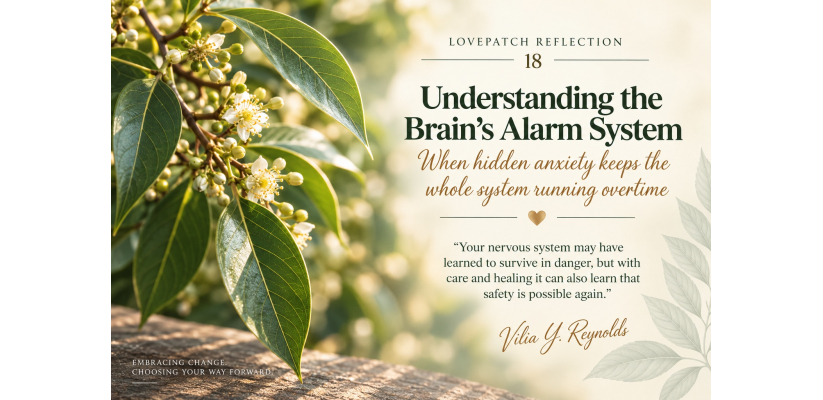
When hidden anxiety keeps the whole system running overtime
By Vilia Y. Reynolds
Sometimes we meet people who appear calm on the outside but are carrying an extraordinary amount of tension within.
They continue working. They care for their families. They fulfil their responsibilities. They smile, participate in conversations and carry on with everyday life.
Yet beneath the surface, something never quite settles.
They may say: Nothing is really wrong, but I just cannot relax. I am exhausted, yet I cannot switch off. I always feel as though something is about to happen. Why am I constantly on edge?
Perhaps they have become so accustomed to living in a state of readiness that they no longer recognise how much energy it requires.
And sometimes, the explanation may involve a nervous system that has learned to remain alert long after a threatening experience has passed.
What if the problem is not that we are failing to relax, but that our internal alarm system has become unusually sensitive to possible danger?
When the Car Never Really Switches Off
Imagine driving a vehicle whose warning systems are continually activated.
The warning lights keep flashing. The accelerator seems unusually sensitive. The headlights are constantly searching the road. The temperature gauge seems difficult to interpret.
And even when the vehicle is parked, it feels as though the engine is still running.
Sooner or later, the vehicle requires attention. Not because it is a bad vehicle. But because its systems are working harder than they need to.
Something similar can happen within our experience of prolonged stress.
Our brains and bodies have remarkable systems designed to help us respond to challenges and danger. When we encounter a threat, our bodies may become more alert. Our heart rate may increase. Our attention becomes focused. Our muscles prepare for action.
Stress-related hormones and neurotransmitters help coordinate these responses. These processes are not inherently harmful. They are part of our capacity to respond and adapt.
But when stress is persistent, or when earlier experiences have increased our sensitivity to threat, we may find it difficult to settle even when immediate danger is no longer present. And living in that state can become exhausting.
When the Brain Keeps Sounding the Alarm
Within the body, several interconnected systems contribute to our responses to stress.
Adrenaline and norepinephrine help us respond quickly to demanding situations, increasing alertness and preparing the body for action. Cortisol supports the body’s management of energy and stress over time.
Other chemical messengers, including serotonin and dopamine, participate in complex processes involving mood, motivation, learning and behaviour. Oxytocin is involved in aspects of social connection, while endorphins contribute to the body’s regulation of pain. Melatonin helps coordinate our sleep-wake rhythm.
These systems do not operate independently. Nor can we determine someone’s emotional condition simply by assuming that one chemical is too high or too low.
But understanding that our physical and emotional experiences are interconnected can help us become more compassionate towards people who struggle with persistent stress.
The car analogy gives us a way to describe some of these experiences. The warning lights may resemble heightened alertness. The sensitive accelerator may remind us of restlessness or feeling easily startled.
The constantly searching headlights may resemble hypervigilance — continually watching for possible danger. The difficulty engaging the parking brake may reflect how hard it can feel to rest when our minds and bodies remain activated.
These are illustrations, not medical tests or direct measurements of brain chemistry. Their value lies in helping us understand what persistent stress may feel like.
When Yesterday’s Danger Influences Today’s Experience
For some people, earlier traumatic experiences can influence how they respond to situations that resemble past danger.
Someone who has experienced unpredictable conflict may become especially attentive to another person’s tone of voice. Someone who has endured betrayal may find uncertainty in relationships difficult to tolerate. Someone who has lived through frightening events may become unusually alert to unexpected sounds or changes in their surroundings.
These responses are not always conscious choices. They may reflect learned patterns of attention, expectation and protection.
But not everyone who feels anxious or easily startled has experienced trauma. Sleep difficulties, medical conditions, present-day stressors, medication effects and many other circumstances can contribute to similar experiences.
This is why we should remain curious rather than immediately assigning a cause. Sometimes we are responding to a genuine concern in the present. Sometimes an earlier experience may be influencing our interpretation. And sometimes several factors are contributing at once.
The important question is not simply: Why am I so anxious?
Perhaps we can also ask: What might my mind and body be responding to? What feels unsafe or uncertain? What support might help me understand what is happening?
When Rest Does Not Feel Restful
One of the difficulties with persistent stress is that physical stillness does not always bring emotional rest.
We may lie down, yet continue thinking. We may feel exhausted, yet struggle to fall asleep. We may sit in a quiet room, yet remain unusually attentive to every sound.
Some people become irritable. Others find concentration difficult. Some withdraw from social activities. Others keep themselves constantly busy because slowing down feels uncomfortable.
These experiences can be frustrating, particularly when others interpret them as weakness, impatience or a lack of motivation.
But sometimes the person is already using considerable energy simply to manage everyday demands.
The invitation is not to excuse harmful behaviour or assume that every response is caused by trauma. It is to recognise that there may be more happening beneath the surface than we can immediately observe.
Understanding can replace judgement. And curiosity can create room for appropriate care.
When Healing Helps Us Recognise Safety Again
Perhaps one of the most hopeful aspects of understanding the brain and nervous system is recognising that human responses are capable of change.
Our brains continue learning through experience. Our responses to stress can be influenced by supportive relationships, healthy routines, appropriate treatment and repeated experiences of safety.
For some people, trauma-focused professional care may help reduce distress linked to earlier events. Others may benefit from learning emotional regulation skills, improving sleep, addressing present-day stressors or developing healthier ways of responding to uncertainty.
There is no single approach that works for everyone. And healing does not mean that our alarm systems must become silent. We still need the ability to recognise genuine danger. Rather, recovery may involve developing responses that are better suited to what is happening now.
Within my Christian understanding, I recognise that healing involves the whole person.
Our physical health, emotional experiences, thoughts, relationships, beliefs and spiritual lives are interconnected.
The biblical understanding of human wholeness offers a meaningful foundation for this perspective, while scientific and psychological knowledge helps us explore the many processes that influence human well-being.
These perspectives do not need to compete. Faith may offer hope, meaning and spiritual comfort alongside appropriate psychological and medical care.
We can pray honestly about our fears while also learning practical ways to care for ourselves. We can seek God’s presence while receiving support from people who understand the difficulties we are experiencing.
And we can recognise that needing help does not diminish our worth.
Your nervous system may have learned to survive in danger, but with care and healing it can also learn that safety is possible again.
Perhaps the most meaningful thing we can offer someone who seems constantly on edge is not another instruction to calm down.
Perhaps it is an opportunity to feel heard. To explore what they are experiencing. To understand what may be contributing to their distress. And to discover that their present life does not always have to be organised around yesterday’s fear.
The warning lights deserve attention. But they do not have to define the entire journey.
A Moment to Explore
When you notice yourself feeling unusually alert, restless or unable to relax, what might help you distinguish between a present concern, an earlier experience and your need for greater understanding or care?
LovePatch Reflections | CRCTC
Embracing Change. Choosing Your Way Forward.
Vilia Y. Reynolds