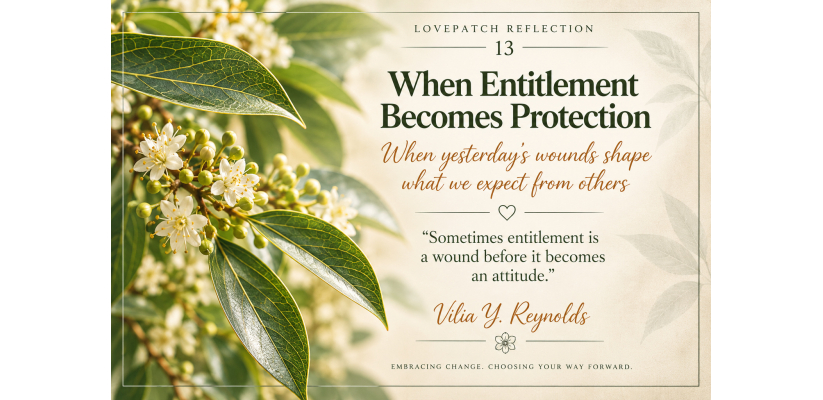
When yesterday's wounds shape what we expect from others
By Vilia Y. Reynolds
Sometimes the attitudes we find most difficult to understand are the very ones that deserve a little more curiosity.
We encounter someone who seems easily offended.
Someone who constantly expects appreciation.
Someone who feels overlooked, unrecognised or disappointed when others do not respond as expected.
And perhaps we quietly conclude:
They are entitled.
They think everyone owes them something.
Nothing is ever good enough for them.
But what if there is another part of the story we have not yet considered?
What if something that looks like entitlement began as an attempt to protect a wounded heart?
When Hurt Becomes an Expectation
We all carry expectations into our relationships.
We want to be respected.
We want to be appreciated.
We want our efforts to be recognised.
We want kindness, consideration and a sense that we matter.
These are meaningful human needs.
But sometimes painful experiences can influence the way we begin expecting others to meet those needs.
Someone who has repeatedly felt rejected may become particularly sensitive to being excluded.
Someone who has experienced neglect may long intensely for acknowledgement.
Someone who has endured criticism may become defensive when their efforts are questioned.
And someone who has experienced betrayal may find it difficult to trust that others will treat them fairly.
Over time, an emotional expectation may begin developing around the wound.
You should appreciate everything I do.
You should recognise how much I have sacrificed.
You should never make me feel rejected again.
You owe me the kindness I did not receive before.
The longing beneath these expectations may be understandable.
But the difficulty begins when we expect people in our present relationships to compensate for pain they did not necessarily cause.
Without recognising it, we may begin keeping an emotional account of everything we believe others owe us.
When Protection Becomes an Attitude
Not every entitled attitude originates in trauma.
Sometimes entitlement develops through learned behaviour, beliefs about fairness, personal expectations or experiences in which demands have repeatedly been rewarded.
But sometimes behaviour that appears demanding or defensive may also have a protective function.
A person may have learned that asking gently did not bring the attention they needed.
That expressing vulnerability resulted in disappointment.
Or that being assertive, demanding or constantly watchful offered some protection against further hurt.
What began as a response to painful experiences may gradually become a familiar way of relating to others.
We become easily offended.
We interpret disagreement as disrespect.
We experience another person's boundaries as rejection.
We begin measuring love by how consistently others meet our expectations.
And when they disappoint us, the old wound may feel newly exposed.
It is as though we have been wearing a protective garment for so long that we no longer notice it.
What once helped us feel protected may now be influencing the very relationships in which we long to feel loved.
Sometimes we mistake the garment for who we are.
Yet a protective response is not the whole of our identity.
When the Wounded Heart Keeps Score
One of the quieter difficulties with entitlement is the emotional accounting that can develop around it.
We begin remembering what we have given.
What we have sacrificed.
What we have tolerated.
What others have failed to acknowledge.
And gradually, the relationship can begin to feel like an unpaid debt.
After everything I have done for you...
You should know how much I need this.
I shouldn't have to ask.
You owe me better than this.
There may be genuine hurt beneath these statements.
Sometimes there may also be legitimate unfairness or a lack of consideration within the relationship.
But when we begin treating every disappointment as evidence that someone has failed to repay us, resentment can quietly grow.
Our attention shifts from understanding one another towards keeping score.
We become increasingly aware of what has not been given to us, while sometimes overlooking the ways we contribute to the relationship ourselves.
The difficulty is not that we have emotional needs.
The difficulty arises when our unmet needs become demands that leave little room for another person's humanity, limitations or choices.
And perhaps this is where the movement towards healing begins.
Not by denying what we have suffered.
But by becoming curious about what our expectations may be protecting.
When Curiosity Replaces Judgement
Instead of immediately condemning ourselves for becoming easily offended, perhaps we can ask a gentler question.
What am I feeling beneath this reaction?
What did I expect from this person?
What does their response mean to me?
Is this expectation connected to something I experienced before?
Am I asking this person to meet a reasonable need, or to repair a wound they did not create?
These questions invite comprehension rather than shame.
They allow us to recognise that our feelings may have a history without assuming that every expectation is justified.
We can acknowledge emotional pain while remaining responsible for how we express it.
We can ask for appreciation without demanding constant reassurance.
We can communicate a need without making another person responsible for our entire sense of worth.
And we can establish healthy boundaries without expecting others to surrender theirs.
Understanding why a protective response developed does not mean we must continue wearing it.
It simply gives us an opportunity to choose differently.
When We No Longer Need Yesterday's Protection
Within my Wardrobe of Love™ understanding, the image of clothing offers a meaningful way to reflect on this journey.
Sometimes painful experiences teach us to wear garments of defensiveness, resentment, mistrust or constant expectation.
We may have worn them for so long that they begin to feel familiar.
Even necessary.
But Colossians 3 invites believers to consider what they are putting off and what they are putting on.
Compassion.
Kindness.
Humility.
Gentleness.
Patience.
Forgiveness.
And above all, love.
These qualities do not require us to abandon our dignity or accept harmful treatment.
Rather, they encourage us to approach ourselves and others with greater awareness, responsibility and grace.
Perhaps putting off an old protective garment begins with recognising why we needed it.
And perhaps putting on love involves discovering that we can be both compassionate and accountable.
We can honour our wounds without making them responsible for every present relationship.
We can recognise our needs without turning them into demands.
And we can learn that our worth does not depend on receiving continual repayment for yesterday's pain.
Sometimes entitlement is a wound before it becomes an attitude.
Perhaps the strongest thing we can do is not to become harder, more demanding or more determined to receive what we believe we are owed.
Perhaps strength begins with the courage to recognise what we have been carrying.
To understand what has been protecting us.
And, when we are ready, to gently loosen our hold on a garment that no longer serves the person we are becoming.
Because healing is not always about adding another layer of protection.
Sometimes it is about discovering that we no longer need to wear yesterday's pain into every relationship today.
A Moment to Explore
When you feel that someone owes you appreciation, understanding or a particular response, what might that expectation reveal about an emotional need, an earlier wound or a protective pattern that deserves your attention?
LovePatch Reflections | CRCTC
Embracing Change. Choosing Your Way Forward.
Vilia Y. Reynolds