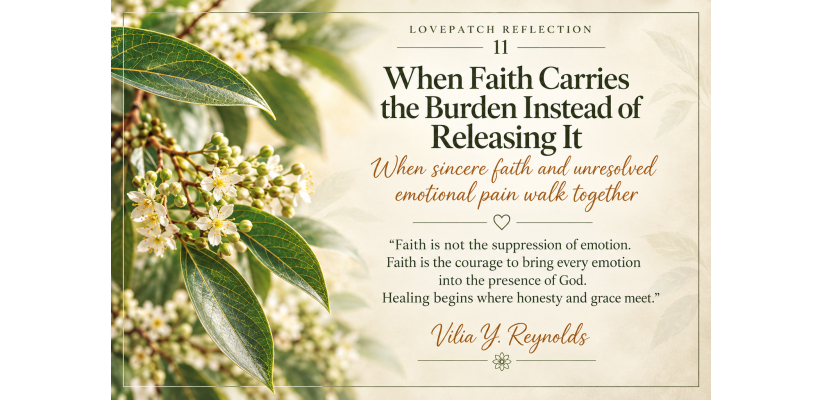
When sincere faith and unresolved emotional pain walk together
By Vilia Y. Reynolds
Sometimes the people carrying the deepest emotional pain are also the people who hold tightly to their faith.
They pray. They read Scripture. They attend church. They believe God's promises.
And when someone asks how they are doing, they may quietly respond:
I'm trusting God. The Lord is in control. I have given it all to Him.
And sometimes, these words express genuine peace and surrender.
But sometimes, beneath those same words, there is a heart still carrying pain that has never been safely acknowledged.
A grief that has never been expressed. A fear that has never been explored. A traumatic experience that continues to influence everyday life.
And perhaps the most difficult part is that the person may not recognise the difference.
They have learned how to speak about faith, but not necessarily how to speak about their pain.
When Spiritual Strength Becomes Emotional Protection
One of the realities I encounter in trauma counselling is that people with sincere and deeply rooted faith may still carry unresolved emotional wounds.
They genuinely love God. They believe His Word. They desire to live faithfully.
Yet somewhere along their journey, they may have learned that expressing certain emotions is a sign of spiritual weakness.
Perhaps they were told:
You must have more faith. You should have forgiven by now. Don't be anxious. Just trust God. Stop looking backwards and move on.
Often these words are spoken with good intentions.
But when someone is already struggling to understand their emotional pain, such encouragement can sometimes become another burden.
They may begin believing that their fear means they lack faith. That their sadness means they have not surrendered. Or that their ongoing emotional struggles reflect something wrong with their relationship with God.
And so they try harder. They pray more. They quote another Scripture. They silence their questions. They push their feelings aside.
Not necessarily because they are unwilling to heal. But perhaps because acknowledging their pain has come to feel unsafe.
Sometimes this pattern is described as spiritual bypassing — using spiritual beliefs or practices to avoid engaging with difficult emotional experiences.
Yet Scripture, prayer and Christian fellowship can also provide genuine comfort, meaning and support.
The distinction is not whether we turn to God. It is whether turning to God allows us to acknowledge our pain or becomes a reason to deny that pain exists.
When the Heart Trusts God but Still Hurts
Trauma can affect how people respond to stress, relationships and reminders of past experiences.
Long after a frightening or overwhelming event has ended, certain reminders may continue to awaken intense emotional or physical responses.
Someone may know that they are safe today, yet still experience fear. They may understand that a relationship has changed, yet continue feeling rejected. They may sincerely believe in God's love, yet struggle with feelings of shame or unworthiness.
These experiences do not automatically indicate a lack of faith.
Nor does every experience of anxiety, anger or sadness necessarily point to unresolved trauma.
But when emotional wounds remain painful, spiritual commitment alone does not guarantee that every aspect of the experience has been processed.
Sometimes a person needs both spiritual encouragement and appropriate emotional support.
And perhaps this is where our understanding of healing needs to become more compassionate.
We can trust God while acknowledging that we are afraid. We can believe His promises while admitting that we are grieving. We can choose forgiveness while recognising that the emotional consequences of what happened may still need care.
Faith does not require us to pretend that pain has disappeared.
When Scripture Makes Room for Emotion
Throughout Scripture, we encounter invitations to trust God amid life's uncertainties.
In Matthew 6:25, Jesus teaches His followers not to be consumed by worry about their lives. His teaching directs our attention towards the Father's care.
But these words should not become a reason to shame someone who is struggling with anxiety or emotional distress.
Likewise, 1 Peter 5:7 invites believers to cast their anxieties upon God because He cares for them.
Notice the tenderness of that invitation.
Our burdens are not dismissed as imaginary. Our anxieties are not treated as something we must hide before approaching God. Instead, we are invited to bring them to Him.
And perhaps this is an important part of surrender.
You cannot honestly surrender what you are unwilling to acknowledge.
Even in the life of Jesus, we see that deep faith and honest emotional expression are not opposites.
At Lazarus' tomb, Jesus wept. In Gethsemane, He spoke openly about His overwhelming sorrow.
He did not present emotional expression as something incompatible with His relationship with the Father.
Instead, His life gives us meaningful examples of grief, sorrow, prayer and trust existing together.
Perhaps healthy Christian spirituality is not about becoming people who no longer feel emotional pain. Perhaps it is about learning to bring our emotional experiences honestly into God's presence.
When Faith and Healing Walk Together
Sometimes we ask God to remove our burdens while continuing to protect ourselves from acknowledging how deeply those burdens have affected us.
We want relief. We want peace. We want to move forward.
But we may be frightened of what we will discover if we begin exploring the pain we have carried.
And that fear deserves compassion.
Trauma-informed care does not require us to force memories into awareness or revisit painful experiences before someone is ready.
Rather, it creates space for safety, choice, understanding and appropriate support.
Sometimes healing involves recognising what has happened. Sometimes it involves learning to respond differently to reminders of the past. Sometimes it means grieving a loss, establishing boundaries or discovering that our feelings can be acknowledged without overwhelming us.
And throughout that journey, faith may remain a meaningful source of courage, hope and connection.
Christian counselling does not need to replace faith with emotional exploration. Nor should it replace appropriate emotional care with spiritual explanations alone.
Faith and healing need not compete. They can become companions.
One offers spiritual meaning and hope. The other helps us explore the emotional experiences that continue to influence our lives.
Together, they can support a more compassionate understanding of ourselves.
When Honesty and Grace Meet
Perhaps one of the gentlest invitations we can offer someone who is hurting is permission to be honest.
Honest about fear. Honest about grief. Honest about anger, disappointment or uncertainty. Honest about the things they do not yet understand.
Not to remain trapped in those emotions. But to acknowledge them without shame.
We do not have to choose between trusting God and recognising our need for care.
We do not have to pretend that our faith has resolved every wound.
And we do not have to carry emotional burdens silently to demonstrate spiritual strength.
Faith is not the suppression of emotion. Faith is the courage to bring every emotion into the presence of God. Healing begins where honesty and grace meet.
Sometimes the prayer, Lord, take this burden from me, may be accompanied by a gentler invitation:
Lord, help me understand what I am carrying, and guide me towards the care I need.
The valley does not disappear simply because we believe in God.
But we can walk through it knowing that our pain does not exclude us from His presence.
And perhaps healing begins when we allow ourselves to approach Him, not as people who have everything together, but as people who are willing to be honest about what still hurts.
A Moment to Explore
When you reflect on the relationship between your faith and your emotional experiences, what feelings or burdens might you need to acknowledge more honestly rather than continuing to carry them in silence?
LovePatch Reflections | CRCTC
Embracing Change. Choosing Your Way Forward.
Vilia Y. Reynolds