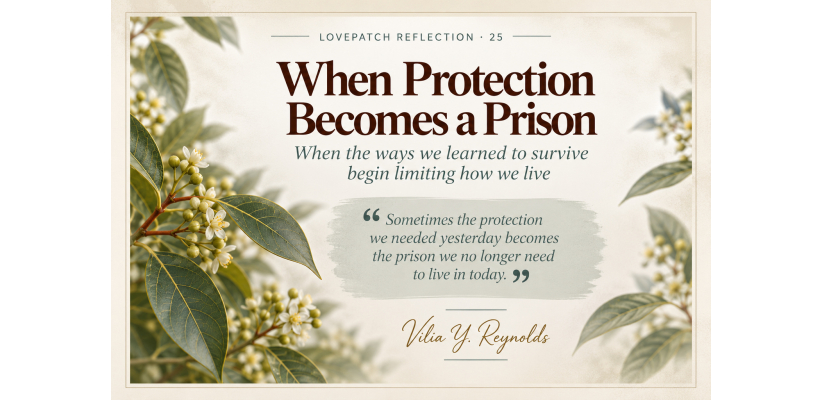
When the ways we learned to survive begin limiting how we live
By Vilia Y. Reynolds
Sometimes the patterns we struggle with today began as ways of protecting ourselves yesterday.
We learned to remain quiet.
To avoid confrontation.
To hide our feelings.
To anticipate disappointment.
To take responsibility for things that were never ours to carry.
And sometimes, without even recognising it, we began telling ourselves stories about what happened.
It was my fault.
I should have done more.
I should have known better.
Something must be wrong with me.
These beliefs may have developed during circumstances when we were frightened, overwhelmed or unable to understand what was happening.
At the time, they may have helped us make sense of experiences that felt beyond our control.
But years later, those same beliefs may continue influencing our choices, relationships and understanding of ourselves.
What once felt like protection may gradually become a limitation we no longer recognise.
When Survival Shapes What We Believe
When people experience overwhelming circumstances, they often search for explanations.
Why did this happen?
Could I have prevented it?
What should I have done differently?
These questions are understandable.
We naturally seek meaning and try to understand experiences that have disrupted our sense of safety.
Sometimes, however, the explanations we develop are not entirely accurate.
A child who experiences rejection may conclude that they are unlovable.
Someone who experiences betrayal may begin believing they cannot trust their judgement.
A person who has endured abuse may carry responsibility for another person's harmful actions.
And someone who has experienced repeated disappointment may begin expecting every future relationship to end the same way.
These beliefs do not necessarily develop through conscious choice.
They may emerge while we are trying to understand circumstances for which we have limited information, resources or control.
And sometimes, blaming ourselves can create an illusion of control.
If it was my fault, perhaps I could have prevented it.
If I become better, perhaps it will never happen again.
But explanations that once seemed to provide certainty can gradually become painful beliefs about who we are.
When Guilt Becomes Part of Our Identity
There is an important distinction between responsibility, guilt and shame.
Responsibility involves recognising what genuinely belongs to our choices and actions.
Guilt may arise when we believe we have done something wrong.
Shame can go further.
Instead of questioning something we did, we begin questioning who we are.
I made a mistake becomes I am a mistake.
Something painful happened to me becomes There must be something wrong with me.
I could not prevent what happened becomes I am weak.
And when these beliefs remain unexamined, they may begin influencing the way we experience everyday life.
We may become perfectionistic because making a mistake feels threatening.
We may avoid difficult conversations because disagreement awakens shame.
We may apologise excessively because we fear being blamed.
Or we may withdraw from opportunities because we have already concluded that we are not capable.
What began as an attempt to protect ourselves from further pain may now be limiting our willingness to participate in life.
Yet a painful belief about ourselves is not necessarily the truth about ourselves.
When Protection Begins Limiting Our Lives
Protective responses can serve meaningful purposes.
Avoiding a genuinely unsafe situation is wise.
Withdrawing temporarily when overwhelmed may allow time to recover.
Setting boundaries can protect dignity and well-being.
But sometimes protective patterns remain active in circumstances where different responses may now be possible.
We may continue expecting rejection even when someone offers genuine acceptance.
We may remain guarded when a relationship has become safer.
We may decline opportunities because earlier experiences taught us to anticipate failure.
And we may continue carrying guilt for things that were never within our control.
This does not mean we should abandon all protection.
Nor does it mean that becoming vulnerable is always safe.
The invitation is to consider whether the responses we learned during earlier experiences are still appropriate for the life we are living today.
Sometimes they are.
Sometimes they need adjusting.
And sometimes they may be ready to change.
When Understanding Begins to Loosen the Bars
Perhaps healing begins when we become curious about the beliefs that have quietly shaped our lives.
Instead of immediately condemning ourselves for being fearful, defensive or withdrawn, we can begin asking different questions.
What did I learn to believe about myself?
What happened that made this belief feel necessary?
Was I genuinely responsible for what occurred?
Am I responding to what is happening today, or to something I learned to expect yesterday?
What might become possible if I considered another explanation?
These questions do not require us to revisit every painful memory.
Nor do they suggest that understanding alone resolves all trauma-related difficulties.
Sometimes meaningful recovery involves professional counselling, appropriate treatment, supportive relationships or present-focused skills.
But greater awareness may help us recognise that a familiar belief is not necessarily an accurate one.
Perhaps we were never responsible for another person's cruelty.
Perhaps being rejected did not mean we were unworthy of love.
Perhaps needing protection did not mean we were weak.
And perhaps the person we became while surviving difficult experiences is not the only person we are capable of becoming.
When We Begin Discovering Who We Are
One of the most meaningful parts of recovery can involve rediscovering our sense of identity.
We may have spent years defining ourselves through painful experiences.
I am the rejected one.
I am the person who failed.
I am the one who cannot cope.
I am the one who must always remain strong.
But our experiences, however significant, do not tell the whole story of who we are.
Within my Wardrobe of Love™ understanding, Colossians 3 offers a meaningful invitation to examine what we have been wearing and consider what we are now called to put on.
Compassion.
Kindness.
Humility.
Gentleness.
Patience.
Forgiveness.
And above all, love.
Sometimes the garments we have worn for protection include self-blame, shame, mistrust or the constant need to prove our worth.
Christian growth may invite us to recognise these familiar patterns and begin approaching ourselves and others differently.
Not by denying what happened.
Not by pretending our wounds have disappeared.
But by allowing our identity to be shaped by more than the experiences that hurt us.
We can acknowledge our pain while remaining open to a more compassionate understanding of ourselves.
When Healing Makes Room for Growth
Sometimes, even after emotional distress begins to lessen, deeper questions remain.
Who am I now?
Where do I belong?
What matters to me?
How do I want to live from here?
These questions may become part of a meaningful journey of personal growth.
Trauma counselling can support people in addressing distress and understanding the effects of overwhelming experiences.
Trauma-informed life coaching, where appropriate, may help people explore values, goals, personal agency and future direction.
These approaches can complement one another, although coaching should not replace necessary mental health treatment.
Growth does not require us to become grateful for what harmed us.
Nor must we transform every painful experience into a positive outcome.
Sometimes growth simply means discovering that we have more choices than we once believed.
We may learn to establish healthier boundaries.
To recognise our strengths.
To ask for support.
To approach relationships with greater discernment.
And to participate in life without allowing every decision to be determined by yesterday's fear.
“Sometimes the protection we needed yesterday becomes the prison we no longer need to live in today.”
Perhaps freedom does not begin by condemning the ways we once survived.
Perhaps it begins by understanding them.
Recognising what they were trying to protect.
Honouring what helped us endure.
And gently considering whether those same responses are still serving us.
Because the experiences that shaped our survival do not have to determine every possibility that lies ahead.
Our story does not end with what happened to us.
And sometimes the journey towards freedom begins when we discover that the door we once needed to keep closed may now be opened safely, one choice at a time.
A Moment to Explore
When you consider the beliefs or protective patterns you developed during difficult experiences, which might still be helping you today, and which may be limiting the person you are becoming?
LovePatch Reflections | CRCTC
Embracing Change. Choosing Your Way Forward.
Vilia Y. Reynolds