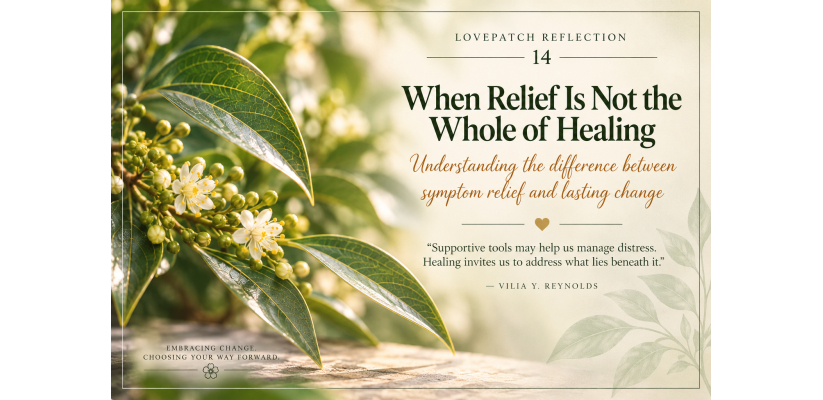
Understanding the difference between symptom relief and lasting change
By Vilia Y. Reynolds
Sometimes we become so focused on finding relief from what hurts that we forget to ask what healing might involve.
We search for something that will help us feel better. A product. A technique. A supplement. A breathing exercise. A new wellness programme.
Something that promises to calm our emotions, relieve our stress or help us manage another difficult day.
And there is nothing necessarily wrong with seeking relief. When someone has been carrying emotional pain for a long time, even a small measure of comfort can make an enormous difference.
But perhaps there is another question worth exploring.
Am I finding ways to manage what I feel, or am I also receiving the care I need to recover?
When Relief Becomes Our Main Goal
We live in a world filled with products, practices and programmes promising to improve our well-being.
Some offer relaxation. Others focus on stress management, emotional regulation, sleep, mindfulness or nervous system calming.
Many of these approaches can be helpful when used appropriately.
Grounding techniques may help someone reconnect with their surroundings. Breathing exercises may support relaxation. Healthy routines, supportive relationships and adequate rest can contribute to emotional well-being.
And professional treatment, including medication when appropriate, may play an essential role in recovery.
These are not insignificant benefits. For someone who feels overwhelmed, becoming more emotionally stable may be an important part of healing.
But sometimes we begin expecting a supportive tool to accomplish more than it was designed to do.
We may repeatedly search for the next technique, hoping it will finally resolve the distress we experience.
And when the relief does not last, we conclude that we need something else. Another product. Another programme. Another remedy.
Perhaps what we need is not necessarily another tool. Perhaps we first need a clearer understanding of what is happening within us.
When Symptoms Tell Only Part of the Story
Trauma can affect how we experience emotions, relationships, memories and everyday situations.
Some people become unusually watchful for danger. Others struggle with intrusive memories, avoidance, emotional numbness or difficulty feeling safe.
Some experience changes in sleep, concentration or their ability to manage stress.
These responses can vary significantly from person to person. And not every symptom of distress is caused by trauma.
This is why careful understanding matters.
A technique that helps someone feel calmer may be valuable without necessarily addressing every difficulty contributing to their distress.
For example, grounding may help a person recognise that they are in the present rather than in a frightening memory. But they may also benefit from appropriate support to understand how past experiences continue to influence their daily life.
Similarly, improving sleep can support emotional well-being, while the reasons for ongoing sleep difficulties may still deserve attention.
The distinction is not that symptom relief is superficial. It is that symptoms do not always tell us the whole story.
Sometimes relief is an important part of recovery. Sometimes it also creates the stability needed for further healing.
When Healing Becomes More Than Feeling Better
What, then, do we mean when we speak about healing?
For me, healing involves more than the temporary absence of distress.
It includes the possibility of living with greater awareness, emotional flexibility, safety, connection and freedom to make meaningful choices.
Sometimes this involves processing traumatic memories with appropriate professional support. Sometimes it involves changing patterns of avoidance or learning to respond differently to situations that once felt threatening.
Sometimes healing includes developing healthy boundaries, rebuilding trust or learning to recognise our needs.
And sometimes significant recovery occurs through approaches focused on present-day functioning, without requiring someone to revisit every painful experience.
There is no single pathway that everyone must follow.
Healing is not measured only by whether someone feels happy. Nor does it require us to find a positive meaning in everything we have suffered.
Post-traumatic growth may emerge for some people, but it is not a requirement for recovery.
What matters is whether the care we receive is appropriate, supportive and helping us move towards healthier functioning and a more meaningful life.
Perhaps lasting change is not about discovering one perfect technique. Perhaps it is about finding the right combination of care for the person and the circumstances.
When Discernment Becomes Part of Care
As a Christian Trauma Practitioner, I believe discernment is an important part of the healing journey.
Not everything that promises healing provides the same level of benefit. Not every approach has been adequately researched. And not every product or programme is appropriate for every person.
This does not mean we must become suspicious of everything. It means we can become curious.
What is this approach intended to do? What evidence supports its use? What are its limitations? Is it appropriate for my circumstances? Am I receiving genuine support, or am I being promised results that cannot be guaranteed?
These questions help us make informed choices without dismissing the value of supportive tools.
In 1 Thessalonians 5:21, Paul encourages believers to test everything and hold fast to what is good.
Although these words arise within a spiritual context, I find the principle of thoughtful discernment meaningful when considering the choices we make about our well-being.
We do not have to accept every claim. We do not have to reject every unfamiliar approach. We can seek understanding, consider the evidence and make thoughtful decisions.
When Faith and Care Walk Together
Within my Christian understanding, healing involves the whole person.
Spirit. Soul. Body.
This reflects the biblical language found in 1 Thessalonians 5:23, where Paul refers to spirit, soul and body.
In science and psychology, we can also consider the interconnected relationship between:
Mind. Brain. Body.
These are different perspectives on human experience, not identical models.
Our thoughts, emotions, physical responses, relationships, beliefs and spiritual lives can influence how we experience ourselves and the world around us.
This does not mean that every difficulty has a spiritual cause, nor that spiritual practices should replace appropriate medical or psychological care.
Rather, I believe faith can provide meaning, hope and spiritual support alongside responsible, evidence-informed approaches to recovery.
Sometimes God's care is experienced through the compassion of another person. Through a safe relationship. Through wise guidance. Through rest. Through appropriate treatment.
Or through the gradual discovery that we no longer have to face everything alone.
And perhaps love also invites us to become more discerning about what we offer people who are hurting.
Instead of simply recommending another product, we can listen. Instead of assuming what someone needs, we can ask. Instead of promising quick results, we can respect the complexity of their experience.
Supportive tools have their place. But the person receiving care must always remain more important than the tool being used.
When Support Becomes Part of Restoration
Sometimes a small moment of relief is exactly what someone needs.
A peaceful night's sleep. A calming exercise. A supportive conversation. A few moments in which overwhelming emotions become more manageable.
We should never underestimate these experiences. But neither should we assume that temporary relief is the only possibility.
For some people, further recovery may involve understanding what has happened, recognising what continues to cause distress and receiving care that supports meaningful change.
The journey may be gradual. It may involve different kinds of support at different times. And it may not look the same for everyone.
Supportive tools may help us manage distress. Healing invites us to address what lies beneath it.
Perhaps the invitation is not to keep searching for the next promise of relief. Perhaps it is to become more attentive to what we genuinely need.
To appreciate the tools that help us. To recognise their limitations. And to seek care that respects the whole person.
Because healing is not a product we purchase. It is a process we participate in, with compassion, discernment and appropriate support.
And sometimes the most meaningful step forward begins when we stop asking only: What can make me feel better? And begin asking: What kind of care will genuinely help me move towards recovery?
A Moment to Explore
When you consider the tools, practices or support you rely on to manage emotional distress, how might you distinguish what provides helpful relief from what may also support your longer-term healing?
LovePatch Reflections | CRCTC
Embracing Change. Choosing Your Way Forward.
Vilia Y. Reynolds