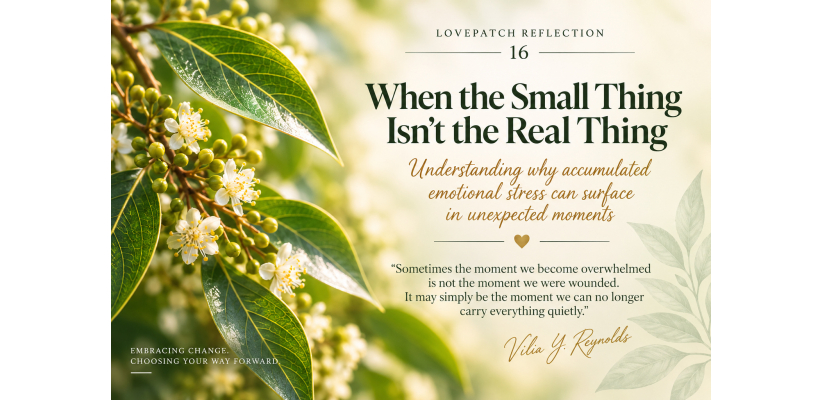
Understanding why accumulated emotional stress can surface in unexpected moments
By Vilia Y. Reynolds
Sometimes we manage the difficult moments remarkably well.
We remain calm during a crisis.
We support someone who is hurting.
We make decisions, fulfil responsibilities and continue doing what needs to be done.
We appear composed. Capable. In control.
Then, hours later, something seemingly insignificant happens.
We cannot find our keys. Someone speaks impatiently. Our phone goes missing. A simple task does not go according to plan.
And suddenly, we feel overwhelmed.
We become tearful, irritable, anxious or unexpectedly angry.
Afterwards, we wonder: Why did I react like that? Why did something so small affect me so deeply? What is wrong with me?
But perhaps there is another question worth asking.
What if the small thing was not the beginning of the emotional burden, but simply the moment we became aware of how much we had been carrying?
When Strength Requires Us to Keep Going
As human beings, we have a remarkable capacity to continue functioning during demanding circumstances.
A parent cares for a sick child. A teacher completes a difficult school day. A nurse continues attending to patients. A police officer responds to an emergency. A trauma practitioner remains attentive to a person experiencing emotional distress.
In these moments, our immediate responsibilities may require considerable focus, composure and self-control.
We may temporarily set aside our emotional responses because something else needs our attention.
And sometimes, this is entirely appropriate.
We cannot always stop in the middle of a crisis to explore everything we are feeling.
But remaining composed does not necessarily mean that an experience has left us unaffected.
After sustained emotional or physical demands, we may have fewer resources available to respond calmly to another difficulty.
What we managed earlier may begin to feel heavier later. And sometimes the smallest additional demand becomes unexpectedly difficult.
When the Last Drop Feels Like the Whole Burden
Imagine carrying a container that is slowly filling throughout the day.
A difficult conversation adds something. An unexpected responsibility adds more. A disappointment. An uncomfortable interaction. A worry that remains unresolved. A moment when we felt frightened but needed to remain calm.
Each experience may place another demand on our attention and emotional resources.
Then something relatively small happens. And the container overflows.
It may appear that the final event caused the entire reaction. But perhaps the response reflects more than that single moment.
This does not mean our nervous system literally stores emotions until they are suddenly released.
Rather, accumulated stress can influence our emotional regulation, concentration, patience and ability to manage additional demands.
Sometimes we notice our distress only after the immediate pressure has passed.
At other times, a seemingly small event may genuinely be upsetting, especially when it touches something personally meaningful.
The invitation is not to dismiss the present experience. It is to consider whether there may be more contributing to our response than we initially realise.
When Self-Judgement Becomes Self-Awareness
Unfortunately, we are often quick to criticise ourselves when our reactions surprise us.
I should be stronger. I'm overreacting. I shouldn't feel this way. Why can't I control myself?
But self-condemnation rarely helps us understand what is happening.
Perhaps a gentler question would be: What have I been carrying today?
That question changes the direction of the conversation.
Instead of immediately judging our behaviour, we begin exploring our experience.
Perhaps we have been under pressure for several hours. Perhaps we have quietly carried worry, disappointment or uncertainty. Perhaps we have been supporting everyone else without recognising our own need for care.
Or perhaps something about the present situation has awakened an earlier emotional experience.
We do not have to assume that every strong reaction is rooted in trauma.
Sometimes we are simply tired. Sometimes we are overwhelmed. And sometimes we need an opportunity to acknowledge what we have not yet had time to feel.
Awareness does not excuse harmful behaviour. But it can help us understand our reactions and take responsibility for what happens next.
When Faith Invites Us to Pause
Within Christian living, we sometimes place considerable emphasis on remaining strong.
We encourage one another to persevere. To trust God. To continue serving. And these are meaningful expressions of faith.
Yet Scripture also gives us examples of people who experienced fear, grief, weariness and emotional distress.
The Psalms contain expressions of deep sorrow, uncertainty and longing for God.
In Psalm 46:10, we encounter the invitation to be still and recognise that He is God.
Within its biblical context, this speaks of acknowledging God's sovereignty amid turmoil.
For me, it also offers a meaningful invitation to consider what happens when we stop striving long enough to become attentive to His presence.
Throughout the Gospels, we also read that Jesus withdrew to pray.
His example reminds us that prayer, reflection and periods of withdrawal can have a meaningful place alongside the responsibilities of serving others.
Perhaps strength is not always found in carrying more. Sometimes wisdom is recognising when we need to pause.
Not because we have failed. But because we are human.
Returning to God With Our Whole Selves
Within my Wardrobe of Love™ understanding, I approach human experience from a Christian perspective that recognises the whole person.
Spirit. Soul. Body.
These words reflect the biblical language of 1 Thessalonians 5:23.
Within science and psychology, we can also explore the interconnected relationship between:
Mind. Brain. Body.
These are different perspectives, not identical explanations of human functioning.
Our thoughts, emotions, physical responses, relationships and spiritual experiences can all influence how we experience the demands of everyday life.
When we become emotionally overwhelmed, we do not necessarily need to choose between prayer and grounding. Between faith and appropriate psychological understanding. Between recognising our emotions and trusting God.
We can acknowledge what is happening within us while remaining attentive to our relationship with Him.
Sometimes this begins with a simple prayer.
Lord, something within me has been stirred. I may not understand everything I am feeling. Help me recognise what I have been carrying. Give me wisdom to know what needs attention, what needs rest and how I can respond with patience and love.
Returning to God's presence does not require us to deny our emotional experiences. We can bring our whole selves before Him.
When We Learn to Respond Rather Than React
Perhaps one of the most meaningful practices we can develop is learning to recognise emotional activation before it determines our behaviour.
We can begin with a gentle sequence:
PAUSE → ACKNOWLEDGE → NAME → CONTAIN WISELY → GROUND → RETURN TO GOD → RESPOND
Pause before reacting. Acknowledge that something within us has been stirred. Name what we may be feeling, without immediately judging ourselves.
Contain wisely when the situation requires us to attend to something else, while recognising that we may need to return to our experience later.
Ground ourselves by noticing our surroundings and reconnecting with the present moment. Return to God through honest prayer. And choose our next response with greater awareness and intention.
These practices do not guarantee that every emotional response will disappear. Nor do they replace appropriate support when distress becomes persistent or difficult to manage.
But they can help us develop a more compassionate and thoughtful relationship with our emotional experiences.
Sometimes the moment we become overwhelmed is not the moment we were wounded. It may simply be the moment we can no longer carry everything quietly.
Perhaps the next time something small feels unusually overwhelming, we can resist the temptation to condemn ourselves.
We can pause. Become curious. Recognise the demands we have been carrying. And consider what kind of care may be needed.
Because the small thing may not be the whole story. And understanding the fuller story can help us respond with greater compassion, wisdom and grace.
A Moment to Explore
When something seemingly small leaves you feeling unexpectedly overwhelmed, what might you discover by gently considering what you have been carrying emotionally, physically or spiritually before that moment?
LovePatch Reflections | CRCTC
Embracing Change. Choosing Your Way Forward.
Vilia Y. Reynolds