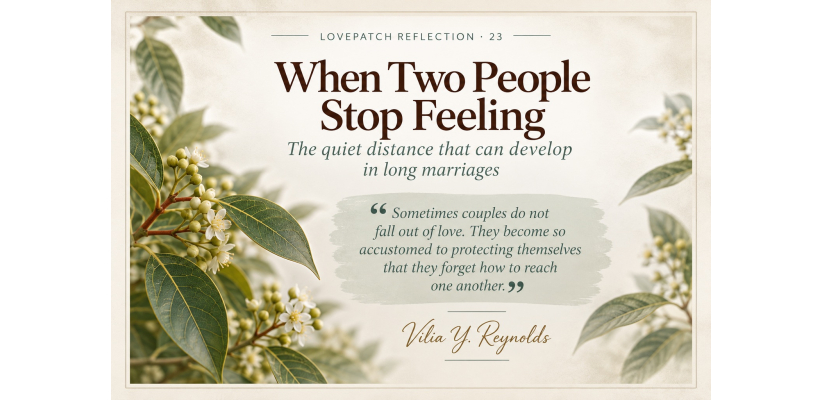
The quiet distance that can develop in long marriages
By Vilia Y. Reynolds
Some couples stay married for forty, even fifty years.
From the outside, their relationship appears to represent commitment.
Loyalty.
Stability.
Perseverance.
They have built a life together, raised families, shared responsibilities and travelled through many seasons.
And perhaps they genuinely value everything they have built.
But sometimes, beneath the familiarity of everyday life, something quieter has been happening.
They have stopped reaching for one another emotionally.
They seldom argue.
They do not necessarily threaten to leave.
They continue doing what needs to be done.
Yet somewhere along the way, they may have become increasingly distant.
Not because love has necessarily disappeared.
But because emotional connection has gradually become less familiar than simply getting through another day.
When Staying Together Becomes Coexisting
There is something meaningful about a marriage that has endured many years.
Shared history, companionship and commitment can provide a deep sense of belonging.
And not every quiet marriage is an unhappy one.
Some couples genuinely enjoy peaceful companionship without needing frequent emotional conversations.
But sometimes the quietness tells a different story.
There may be very little conflict because difficult subjects are seldom discussed.
There may be little disagreement because one or both partners have stopped expressing what they need.
And there may be few emotional conversations because vulnerability has become uncomfortable.
They know how to organise their household.
They know their routines.
They know what responsibilities belong to whom.
But they may no longer know what is happening within one another.
The relationship continues functioning.
Yet emotional intimacy may have slowly become something they remember rather than something they experience.
When Two People Learn Different Ways to Cope
Sometimes emotional distance develops through patterns neither partner fully recognises.
One person may begin withdrawing.
They speak less.
Share fewer feelings.
Avoid difficult conversations.
They may appear emotionally flat or uninterested.
The other partner may respond quite differently.
They remain busy.
They organise.
They take responsibility.
They stay cheerful, positive or constantly occupied.
From the outside, they may appear to be coping remarkably well.
Yet busyness can sometimes become a way of avoiding emotional discomfort.
And withdrawal can sometimes become a way of protecting oneself from disappointment, conflict or vulnerability.
These patterns do not always originate in trauma. They may also be influenced by temperament, relationship history, illness, grief, chronic stress or personal expectations.
But when both partners become accustomed to coping in different ways, something important may happen.
They begin adjusting to one another's protective responses rather than exploring what lies beneath them.
One learns not to ask too much.
The other learns not to reveal too much.
And gradually, emotional distance becomes part of the relationship's familiar rhythm.
When Silence Becomes an Unspoken Agreement
Perhaps one of the saddest aspects of emotional disconnection is that it does not always announce itself.
There may be no dramatic argument.
No obvious crisis.
No moment when either person consciously decides to withdraw from the relationship.
Instead, something develops quietly.
You don't come too close.
And I won't ask you to.
We won't discuss what hurts.
We will simply carry on.
Neither person may ever express these words.
Yet their behaviour begins reflecting an unspoken agreement.
One partner stops asking for emotional closeness because earlier attempts seemed unsuccessful.
The other stops initiating meaningful conversations because silence feels easier.
Eventually, both become accustomed to the distance.
Not necessarily because they are content.
But because the pattern has become familiar.
And sometimes familiar discomfort can feel easier to manage than the uncertainty of change.
When Functioning Is Mistaken for Connection
Couples may continue fulfilling every visible responsibility while privately experiencing emotional loneliness.
They attend family gatherings.
Celebrate birthdays.
Support their children.
Manage finances.
Share a home.
And perhaps everyone around them believes they have a successful marriage.
But the ability to function together does not automatically mean that emotional connection is present.
One partner may feel unseen.
Another may feel overwhelmed.
One may long for conversation.
The other may not know how to begin.
And sometimes both have become so accustomed to their roles that they no longer recognise their own emotional needs.
They may say:
This is simply how marriage is.
We have been together this long.
There is nothing really wrong.
Perhaps those statements reflect genuine contentment.
But sometimes they conceal a quieter question.
Is this all our relationship has become?
When Understanding Replaces Blame
It is easy to look at emotional distance and begin identifying who has withdrawn or who has stopped trying.
But perhaps a more meaningful conversation begins when we become curious about how the pattern developed.
What made emotional openness difficult?
When did talking begin to feel uncomfortable?
What happened when one partner needed support?
How did both respond to disappointment or vulnerability?
And what have they learned to expect from one another?
These questions do not excuse hurtful behaviour.
Nor do they suggest that both partners necessarily contributed equally to the difficulty.
Sometimes one person has repeatedly attempted to reconnect while the other has remained unavailable.
Sometimes unresolved conflict or chronic stress has created distance.
And where coercion, intimidation or abuse is present, emotional safety must take priority over attempts to increase closeness.
But in relationships where both partners are safe and willing to explore change, curiosity may create opportunities that blame cannot.
Instead of immediately asking:
Why don't you ever talk to me?
Perhaps we might gently ask:
When did it become difficult for us to share what we feel?
And instead of assuming that silence means indifference, we may begin exploring what makes emotional expression difficult.
When Love Makes Room for Connection Again
Perhaps reconnecting does not begin with demanding that two people become emotionally expressive overnight.
Sometimes it begins with a small moment of genuine attention.
A question asked without criticism.
A conversation without immediately offering solutions.
A willingness to hear something uncomfortable.
A moment in which one person feels safe enough to say:
I miss feeling close to you.
And another feels able to respond:
I don't quite know how we became so distant.
Within Christian living, Colossians 3 invites us towards compassion, kindness, humility, gentleness, patience and love.
These qualities are not simply ideals for peaceful relationships.
They can also influence the way we approach someone with whom we have become emotionally distant.
Gentleness creates room for honesty.
Patience allows change to unfold gradually.
Humility encourages us to consider another person's experience.
And love invites us to recognise that connection requires more than sharing responsibilities.
It requires opportunities to be known.
Sometimes couples do not fall out of love. They become so accustomed to protecting themselves that they forget how to reach one another.
Perhaps the journey back towards connection is not about returning to the people we were many years ago.
We have changed.
Life has changed.
Our needs, expectations and circumstances may have changed.
But perhaps we can begin discovering who we are now.
Not simply as two people sharing a home.
But as two people who may still have something meaningful to learn about one another.
Because remaining together is one expression of commitment.
Learning to remain emotionally present with one another may become another.
And sometimes love begins speaking again when two people are finally willing to listen.
A Moment to Explore
When you consider a long-standing relationship in your life, what might help you recognise whether its quietness reflects peaceful connection or an emotional distance that deserves gentle attention?
LovePatch Reflections | CRCTC
Embracing Change. Choosing Your Way Forward.
Vilia Y. Reynolds